The gap between high-performing home-based care agencies and the rest is widening.
Demand for home health and hospice services remains strong. Demographics are favorable. The value of care in the home is well established. Yet many organizations are struggling to translate demand into sustainable growth, predictable margin, and operational confidence.
According to The State of Home-Based Care in 2026, the difference is no longer market position or service mix alone. It is mindset and execution. The agencies pulling ahead are thinking differently about operations, technology, and scale and are using care management software as a strategic backbone rather than a collection of tools.
From keeping up to pulling ahead
For CEOs, this is a defining moment. For years, agencies could survive with incremental improvements. A new intake process here, a scheduling adjustment there, or a documentation fix when compliance issues surfaced. That approach is breaking down.
The report makes clear that reimbursement pressure, Medicare Advantage complexity, rising oversight, and workforce constraints have converged. In this environment, disconnected fixes no longer compound into enterprise-level gains. They create friction instead.
High-performing organizations are moving beyond departmental optimization and adopting a system-level view of performance from referral to final billing.

What separates leaders from those treading water
The agencies pulling ahead in 2026 share several defining characteristics.
First, they treat operations as an executive system. Referral intake, authorization, scheduling, care delivery, documentation, billing, and analytics are managed as interdependent workflows. Leaders understand that a delay or error upstream will surface later as lost revenue, strained payer relationships, or audit exposure.
Second, they recognize that clinician time is the scarcest resource they have. Workforce shortages persist nationally, and hiring alone cannot close the gap. Instead of pushing more patients onto already stretched teams, leading agencies focus on removing administrative friction and low-value work so clinicians can operate at the top of their license.
Third, they align technology investment with operational outcomes. Rather than adding point solutions, they rely on care management software that connects workflows, standardizes execution, and provides visibility into performance across the organization.
Why care management software has become strategic
Care management software platforms are no longer just an IT decision. They are a growth strategy.
The report emphasizes that as Medicare Advantage becomes the dominant operating reality, agencies must manage increasing authorization requirements, payer-specific documentation standards, and tighter turnaround expectations. Kaiser Family Foundation data cited in the report shows Medicare Advantage enrollment has surpassed half of all eligible Medicare beneficiaries and plans process tens of millions of prior authorization requests annually. Even small inefficiencies at intake or documentation can ripple into delayed starts of care and unpredictable cash flow.
Leading agencies use care management software to:
- Treat intake, authorization, and start of care as a single throughput system
- Standardize documentation to support both quality performance and audit readiness
- Reduce manual handoffs between field and office teams
- Use analytics to identify bottlenecks before they affect margin or access
This connected approach allows improvements in one area to translate into results across the enterprise.
Operational discipline is now a competitive advantage
One of the report’s central conclusions is that operational reliability is becoming the deciding factor for access, contracts, and sustainable growth.
CMS policies reinforce this shift. Expanded Home Health Value-Based Purchasing ties reimbursement directly to quality outcomes. Hospice oversight has intensified, and the transition to HOPE raises expectations for defensible execution and timely submissions. Medicare Advantage continues to reward organizations that can demonstrate speed, consistency, and outcomes at scale.
For CEOs, this means that care management software choices are not about convenience. They are about creating an operating model that can absorb complexity without overloading teams or increasing risk.
Technology without connection is no longer enough
Many agencies have invested in home health and hospice software over the years. The report cautions, however, that disconnected systems often shift work instead of removing it.
Scheduling optimization that does not account for documentation workflows can shift burden downstream to clinical or billing teams. A documentation tool that increases back-office rework undermines productivity gains made in the field. A reporting system that highlights problems only after revenue is already lost limits leaders’ ability to intervene in time. These patterns are common among organizations.
The agencies pulling ahead are deliberate. They invest in platforms that connect workflows end to end, embed compliance guardrails, and surface actionable insights early enough to act.
A CEO’s lens on 2026 priorities
From a CEO perspective, the question is not whether demand exists. It is whether the organization is built to capture it.
The report highlights several priorities that consistently show up among high-performing agencies:
- Managing operations as a connected system, not a set of departments
- Using data to link execution, quality, and financial outcomes
- Investing in care management software that scales with payer and regulatory complexity
- Treating productivity and retention as growth strategies, not HR issues
- Embedding compliance and audit readiness into daily workflows
These choices reflect a shift from reactive problem-solving to intentional design.
Why the gap will continue to widen
The report’s 2026 outlook is direct. Home-based care will increasingly divide into two groups: organizations running connected, measurable operating models and organizations relying on manual workarounds and siloed processes. Demand will not be the differentiator. Operational reliability will be.
Care management software sits at the center of that divide.
Agencies that use them to connect people, processes, and data will continue to unlock capacity and protect margin. Those that treat them as isolated tools will struggle to keep pace as expectations rise.
Get the full executive perspective
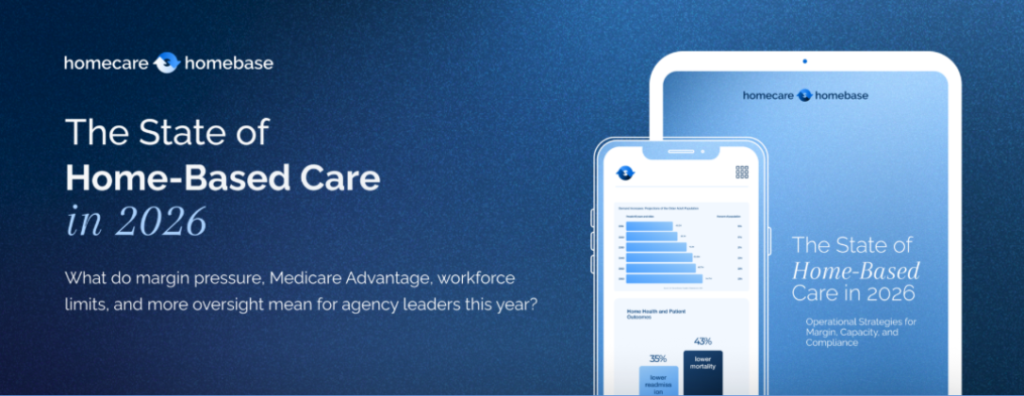
Download The State of Home-Based Care in 2026 for a clear, credible, data-informed view of the forces shaping Medicare and Medicare Advantage and the operational priorities CEOs must address to respond.
Or, if you are assessing your organization’s readiness, see how leading agencies are structuring their operations for 2026 and use a practical framework to guide strategy, prioritization, and investment decisions.
The full report translates regulatory, payer, and workforce complexity into clear, executive-level guidance for home-based care leaders navigating the year ahead.