For CFOs in home health and hospice, margin pressure in 2026 is not coming from a single line item. It is coming from dozens of small delays that compound across the organization.
Late starts of care. Missed or rescheduled visits. Documentation rework. Authorization backlogs. Incomplete claims. None of these appear on a P&L as “operational friction.” Yet together, they are steadily eroding revenue cycle performance, slowing cash flow, and weakening referral confidence.
According to The State of Home-Based Care in 2026, agencies that outperform in the coming year will be those that treat operations as a financial control system rather than a series of departmental tasks.
For CFOs, the takeaway is clear: revenue cycle management has become inseparable from operational execution.
Why Operational Friction Is a Revenue Cycle Problem
Revenue cycle management in home health and hospice has traditionally focused on billing accuracy, collections, and days sales outstanding (DSO). In 2026, those metrics are still critical, but they are increasingly converting to downstream indicators.
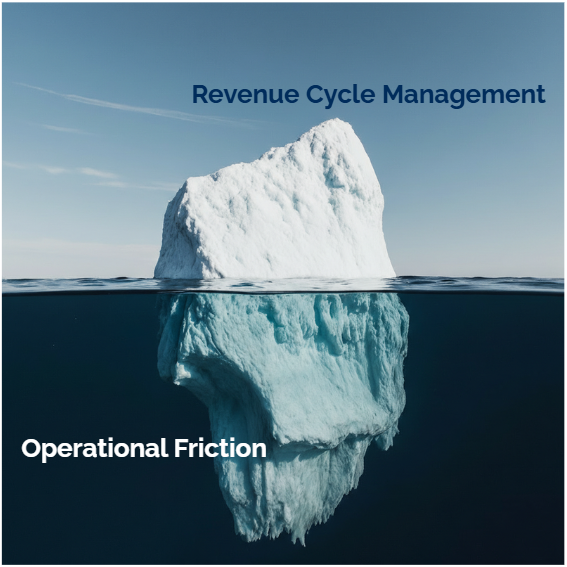
The real drivers of financial performance now sit earlier in the workflow.
The 2026 industry report highlights that every delay, missed requirement, or preventable rework request shows up in margin, cash flow, and referral confidence. CFOs see this play out in several ways:
- Slower time from referral to start of care delays revenue recognition
- Documentation gaps lead to denials, rework, and extended accounts receivable
- Missed visits increase LUPAs and reduce episode profitability
- Authorization delays under Medicare Advantage disrupt scheduling and throughput
- Inconsistent execution undermines payer and referral source trust
Individually, these issues may appear operational. Collectively, they are financial.
Medicare Advantage Is Amplifying Revenue Cycle Risk
Medicare Advantage is no longer a future consideration. It is the dominant operating reality.
Kaiser Family Foundation reports that Medicare Advantage enrollment reached 34.1 million people in 2025, representing 54% of eligible Medicare beneficiaries. In the same year, Medicare Advantage accounted for $462 billion in federal Medicare spending.
The report confirms this shift operationally. Nearly half of patients served on the Homecare Homebase platform are now covered by Medicare Advantage, bringing with them payer-specific documentation rules, utilization management, and prior authorization requirements.
For CFOs, this matters because Medicare Advantage introduces:
- Greater variability in intake and authorization timelines
- Higher administrative labor costs
- Less predictable cash flow
- Increased risk of denials tied to documentation completeness and timing
KFF data shows that 6.4% of Medicare Advantage prior authorization requests were denied in 2023, and while only 11.7% were appealed, more than 82% of appealed denials were partially or fully overturned. Each denial represents delayed care, delayed revenue, and added administrative expense.
Quality Performance Is No Longer Just a Compliance Issue
Another key finding from the report is that quality performance has become a revenue lever, not just a reporting obligation.
CMS’s expanded Home Health Value-Based Purchasing model now applies payment adjustments of -5% to +5% based on performance. CMS’s evaluation of the original HHVBP demonstration linked improved quality scores to reduced hospitalizations, lower SNF utilization, and hundreds of millions in Medicare savings.
From a CFO perspective, this means:
- Timely starts of care affect both quality scores and revenue realization
- Visit execution consistency influences both outcomes and billing
- Documentation accuracy supports both audit defense and reimbursement
In hospice, oversight is intensifying as well. CMS increased penalties for failure to submit required quality data, and the transition to the HOPE tool introduces new visit types and strict timing expectations. The report emphasizes that “audit-ready” is now a requirement for daily operation, not an annual exercise.
Revenue cycle management now depends on defensible execution, not just clean claims.
Workforce Constraints Turn Time into a Financial Variable
Operational friction is also magnified by workforce limitations.
The U.S. Census Bureau projects that by 2030, one in five Americans will be 65 or older, while the Bureau of Labor Statistics projects 17% growth in home health and personal care aide jobs through the next decade. Demand is rising faster than capacity.
The report shows that agencies are serving more patients overall, yet referral conversion rates have declined over time due to staffing constraints and operational bottlenecks. In 2024 alone, over 4.2 million individuals did not receive recommended home health services, despite physician orders.
For CFOs, clinician time is now a financial variable:
- Excess documentation time increases labor cost per visit
- Burnout and turnover increase replacement and onboarding costs
- Missed visits and reschedules affect revenue integrity
Improving revenue cycle outcomes without addressing operational efficiency is no longer realistic.
Treating Operational Friction as a Financial Control Strategy
One of the most important insights in the 2026 report is the recommendation that agencies track operational friction as a financial concern.
Examples of metrics to examine include:
- Time from referral to start of care
- Missed visit, LUPA and Outlier rates
- Documentation completion timeliness
- Clean claim rates and denial trends
- Unbilled revenue relative to net revenue
The report argues that agencies that connect referral, intake, scheduling, care delivery, documentation, billing, and analytics into a single operating model are better positioned to protect margin and cash flow.
This is where revenue cycle management evolves from a back-office function into an enterprise discipline.
What CFOs Should Prioritize Heading into 2026
Based on the findings in The State of Home-Based Care in 2026, CFOs should focus on three priorities:
- Throughput over volume
Growth depends on how reliably the organization can move patients from referral to final billing, not just how many referrals arrive.
- Upstream prevention over downstream correction
Preventing documentation gaps and delays reduces denials, rework, and audit exposure later.
- Connected visibility over siloed reporting
Financial outcomes improve when operational bottlenecks are visible early enough to act.
These priorities position revenue cycle management as a strategic lever, not a reactive function.
Download the Full Report: A Practical Guide for CFOs
This blog is an introduction to the data and strategies outlined in the full report.
The State of Home-Based Care in 2026 provides a clear, executive-level view of the regulatory, payer, workforce, and operational forces shaping home health and hospice. It translates complexity into practical priorities CFOs can use to protect margin, improve cash flow, and strengthen referral confidence.
Download the full report to see how agencies are quantifying and addressing operational friction as a financial control strategy. The report includes data-informed insights, operational benchmarks, and an execution playbook designed for executive leaders navigating Medicare and Medicare Advantage in 2026.