
Artificial intelligence has been part of healthcare for decades. But the healthcare AI trends in 2026 signal something fundamentally different: AI is no longer a tool clinicians visit, it’s becoming a key resource as they deliver care.
For home health and hospice organizations, this shift matters. The future of AI in home health and hospice is not about isolated innovation. It’s about embedding intelligence directly into clinical workflows, supporting decisions in real time, and helping teams navigate increasing complexity with greater clarity.
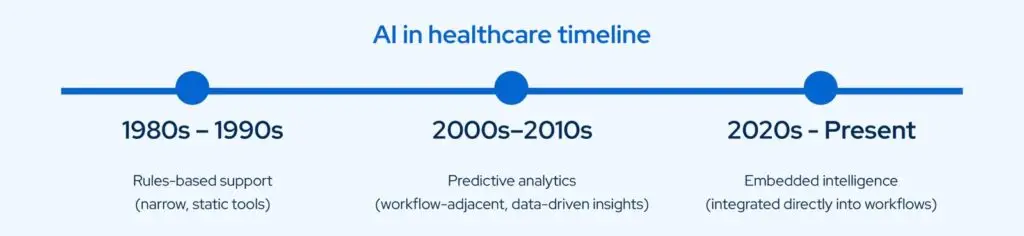
The history of AI in healthcare: From rules to real-world application
Early AI: Rules-based decision support
The earliest forms of healthcare AI were rule-based systems. These tools applied predefined logic to clinical or administrative scenarios, such as medication checks or diagnostic prompts.
They introduced important capabilities, but they had limitations:
- Static logic that didn’t adapt over time
- Limited clinical context
- Required clinicians to step outside their workflow
Even in this early phase, one principle became clear: trust determines adoption. If clinicians couldn’t validate or understand AI outputs, they wouldn’t use them.
Machine learning expansion: Capturing more insight
As healthcare data expanded, machine learning introduced more advanced capabilities:
- Risk stratification
- Pattern recognition across populations
- Operational forecasting
These advancements marked a turning point. AI could now identify patterns humans couldn’t easily detect.
But there was a gap.
Most insights lived in dashboards, not workflows. Teams could see risk, but accessing the information was still cumbersome and it was not always available at the point of care. This limited real-world impact, especially in challenging care environments like home-based care.
Generative AI: A shift toward usability
In the early 2020s, generative AI accelerated adoption by making AI more accessible.
It began supporting:
- Clinical documentation drafting
- Patient summary creation
- Referral data extraction
- Communication between care teams
For the first time, AI directly addressed clinician pain points like documentation burden and after-hours work. But early implementations revealed a challenge: generating content does not mean that content is compliant.
In home health and hospice, documentation must meet structured requirements (OASIS, HOPE), support coding, and align with compliance standards. Narrative output alone doesn’t solve these downstream needs.
Healthcare AI trends in 2026: The shift to embedded intelligence
The defining characteristic of healthcare AI trends in 2026 is the move from tools to embedded intelligence.
AI is no longer separate from the workflow. It is part of it.
This shift includes:
- Real-time support during clinical documentation
- Automated data extraction at intake
- Continuous visibility into patient risk
- Workflow-aligned decision support
Instead of adding steps, AI is reducing friction. For home-based care, where clinicians operate across homes, offices, and mobile environments, this matters. Technology must adapt to how care is delivered, not the other way around.
Predictive insight in clinical workflows: Supporting better decisions at the point of care
Home-based care is one of the most complex environments for healthcare delivery. Clinicians operate independently, often making decisions in the moment with incomplete information. This is where predictive AI is becoming more meaningful as a clinical support tool.
Machine learning models can analyze a wide range of patient-specific data to surface insights about a patient’s likelihood of hospitalization in the near term.
Some of these data points include:
- Diagnoses and comorbidities
- Medications and changes over time
- Vital signs and assessment inputs
- OASIS and other structured clinical data
These insights are presented directly within the clinician’s workflow, where they can be evaluated alongside the full clinical picture.
The role of this type of AI is clear:
- Help highlight potential risk earlier
- Provide visibility into contributing factors
- Support more informed clinical decision-making
It does not prescribe action. It does not replace judgment. The clinician remains responsible for interpreting the information and determining the appropriate next steps.
When acted on, these insights can lead to:
- Adjustments in care plans
- Changes in visit frequency or interventions
- More proactive monitoring of patient conditions
Predictive AI helps strengthen clinical awareness and acts as a co-pilot, providing helpful information, while keeping the decision-making where it belongs, in the hands of the experts.
AI and documentation: From generation to structured intelligence
Documentation remains one of the most impactful use cases for AI.
But the trend is shifting. Early tools focused on generating text. In 2026, value comes from structured, workflow-aligned documentation support.
In home health and hospice, documentation must:
- Populate structured assessments (OASIS, HOPE)
- Support coding accuracy and reimbursement
- Meet audit and compliance standards
- Align with care plans and quality measures
AI is evolving to support these requirements directly, helping clinicians document more efficiently while maintaining accuracy and compliance.
The future of AI in home health and hospice
The future of AI in home health and hospice is not about replacing clinical expertise. It’s about strengthening how clinicians work.
AI is expanding across four key areas:
1. Clinical decision support
Providing earlier visibility into patient needs and helping teams act proactively.
2. Documentation workflows
Reducing administrative burden while improving accuracy, completeness, and compliance.
3. Care coordination
Connecting data and teams to support better timing and consistency of care.
4. Operational and financial performance
Improving documentation quality, reducing errors, and supporting more efficient revenue cycle processes.
Across all areas, one principle remains constant: clinician control and transparency are essential.
As AI becomes more embedded, its impact connects directly to quality and performance. One of the ways home-based care agencies can demonstrate value is to reduce avoidable hospitalizations and emergency department use for their patients through timely interventions. AI can help support this goal by surfacing valuable insights and saving clinicians time during the documentation process so they can focus more on their patients.
AI solutions in 2026: What to look for
As organizations evaluate AI, the focus should shift from features to real-world impact.
Key considerations include:
- Does the AI work within existing workflows?
- Does it support structured, compliant documentation?
- Does it provide clear, explainable insights?
- Does it help teams act earlier, not just analyze later?
The most effective AI feels like part of the care process, not an additional layer.
The next phase of healthcare AI
The story of AI in healthcare is no longer about what the technology can do. It’s about how it fits into care delivery.
The healthcare AI trends in 2026 point to a future where intelligence is:
- Embedded, not separate
- Predictive, not reactive
- Actionable, not theoretical
For home-based care organizations, this represents a meaningful opportunity to operate with greater clarity, support clinicians more effectively, and improve outcomes in a complex environment.
As the future of AI in home health and hospice continues to evolve, success will depend on aligning technology with the realities of care, supporting people, strengthening coordination, and enabling better decisions at the right time.
Download the AI in Clinical and Revenue Operations report to see how workflow-embedded, clinician-guided intelligence is supporting documentation, strengthening decision-making, and improving operational clarity across home health and hospice.
 AI in Clinical and Revenue Operations report