Documentation is a critical operational function in home-based care. Across home health, hospice, personal care, and private duty, agencies rely on accurate, timely clinical records to support care coordination, compliance, reimbursement, and operational oversight.
At the same time, documentation requirements have grown more complex. Clinical leaders and operations teams are increasingly tasked with balancing documentation quality, clinician capacity, and regulatory readiness across multiple service lines and payer models.
AI scribing is emerging as one way agencies are exploring how to support documentation workflows more efficiently. Rather than replacing clinical judgment, AI scribing is designed to assist clinicians by capturing visit information and organizing it for review. For agency leaders, the value lies in how this technology can support documentation consistency, reduce rework, and strengthen downstream operational processes.
Understanding AI scribing in a home-based care context
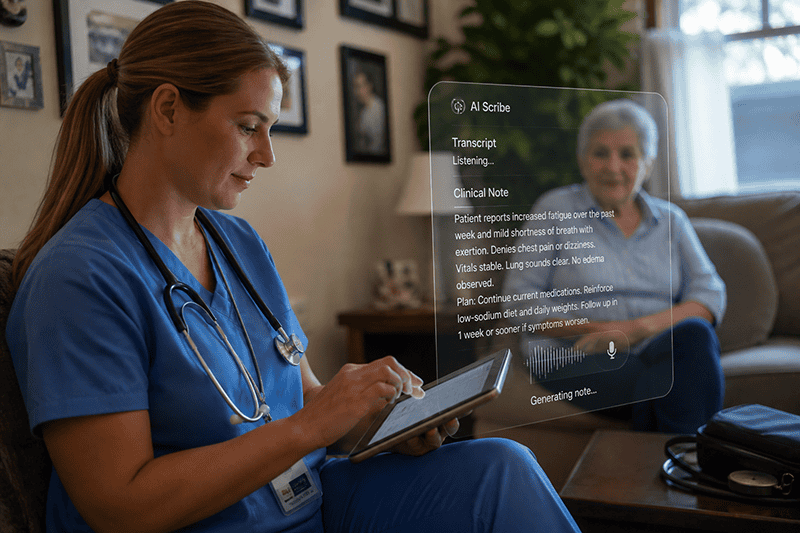
AI scribing uses artificial intelligence to assist with converting spoken patient–clinician interactions into structured clinical documentation. During a visit, an AI scribing tool listens in the background and captures relevant clinical information, such as symptoms, medications, assessments, and care plans.
The system then organizes that information into a draft clinical note. The clinician reviews the note, makes any necessary edits, and approves it before it becomes part of the official patient record. At no point does AI replace clinical decision-making or remove clinician accountability for documentation accuracy.
For home-based care agencies, this model is particularly relevant because visits occur in varied environments and documentation is often completed later in the day. AI scribing supports capturing details closer to the point of care while preserving required review and oversight.
How AI scribing works
While implementations vary, most AI scribing workflows follow a similar structure:
1. Ambient listening during the visit
Speech recognition technology captures the conversation between the clinician and patient. The system differentiates speakers and filters out non-clinical dialogue.
2. Structuring clinical content
Natural language processing organizes the captured information into predefined documentation formats or narrative visit summaries, based on organizational standards.
3. Clinician review and approval
The clinician reviews the draft note, edits content as needed, and confirms accuracy before finalizing documentation.
This review step is essential. AI scribing supports documentation efficiency, but clinicians remain responsible for ensuring notes meet clinical, regulatory, and organizational requirements.
From conversation to structured documentation
Unlike traditional dictation tools, AI scribing is designed to recognize clinical context. It can distinguish between patient-reported information, clinician observations, and care planning discussions, helping place information into appropriate sections of the record.
For operations leaders, this capability can help address common documentation challenges, including:
- Missing or incomplete fields
- Inconsistent narrative structure across clinicians
- Delays in documentation completion that create downstream rework
By supporting more structured documentation at the point of capture, AI-assisted workflows can reduce the need for back-office follow-up and clarification.
Supporting operational workflows across service lines
When embedded within an electronic health record, AI scribing can support more efficient documentation workflows across different home-based care models.
- Home health and hospice: Structured clinical notes support compliance with Medicare Conditions of Participation, quality reporting requirements, and audit readiness. AI scribing does not replace regulatory requirements, but it can help reduce documentation gaps that contribute to rework or risk.
- Personal care and private duty: While regulatory requirements differ and are often driven at the payer or state level, consistent documentation remains critical for care continuity, authorization and billing support, and operational oversight.
In all cases, AI scribing is most effective when it fits into existing workflows and reinforces required documentation standards rather than introducing parallel processes.
Why AI scribing matters for agency leaders
For agency executives and operations leaders, the relevance of AI scribing extends beyond clinician convenience. Documentation quality directly affects:
- Revenue cycle performance
- Compliance and audit preparedness
- Care coordination across teams
- The ability to scale operations without adding administrative overhead
AI-assisted documentation can help reduce rework caused by missing information or inconsistent notes. While outcomes vary by agency and implementation, improving documentation consistency can support more predictable downstream workflows for billing, quality review, and reporting.
Patient experience and care delivery
AI scribing operates in the background of the visit, allowing clinicians to focus on patient interaction rather than navigating screens. For home-based care, where trust and presence are central to care delivery, minimizing documentation distractions can support better engagement.
From an operational perspective, timely and accurate documentation also supports faster communication between field staff and office teams, improving responsiveness to patient needs.
Data accuracy, privacy, and regulatory considerations
Any use of AI in clinical documentation must be approached with appropriate safeguards. AI scribing tools are designed to support HIPAA-aligned data protection practices, including encryption and controlled access. It is important for agencies to develop processes that capture patient consent before utilizing an AI scribing tool because it requires that the patient’s interactions be recorded in order to generate visit summaries. Also consider the presence of other people in the home. Since ambient scribing requires the clinician to narrate as they provide care, it is possible that other members of the household may overhear sensitive patient information. If the patient does not wish to disclose their care details, it may be necessary to move behind closed doors before using a scribe.
Equally important is governance. Because clinicians review and approve all documentation, AI scribing supports a human-in-the-loop model that aligns with regulatory expectations across care settings. This oversight is especially critical in Medicare-certified home health and hospice environments, where documentation accuracy is closely tied to compliance and reimbursement.
The role of AI scribing in a broader home-based care strategy
AI scribing is not a standalone solution. Its value increases when it is part of a connected documentation and data strategy that supports clinical, operational, and financial workflows.
For agency leaders, the question is not whether AI replaces documentation work, but how it can support more reliable, consistent documentation while preserving clinical judgment and regulatory integrity. When implemented thoughtfully, AI-assisted documentation can help agencies strengthen operational discipline without increasing administrative burden.
Moving forward
As documentation requirements continue to evolve across home-based care, agency leaders are evaluating tools that support both efficiency and accountability. AI scribing represents one approach to assisting documentation workflows that keeps clinicians in control and compliance front and center.
Understanding how AI scribing works, where it fits, and where human oversight remains essential is a critical first step for organizations exploring its role in their operations.
Download our report: AI in Clinical and Revenue Operations to explore the strategies organizations are using to bring AI into home-based care.
 AI in Clinical and Revenue Operations