
Referral growth looks good on a dashboard. But the number of referrals coming through the door tells you very little about whether that volume can become sustainable growth. A referral has to make it through intake, meet clinical and eligibility requirements, navigate payer requirements, be staffed appropriately, move into care on time, and ultimately support complete documentation and reimbursement. Friction at any of those points can add administrative work, delay care, consume limited capacity, or create downstream financial risk.
The more useful question isn’t simply, “How many referrals are we getting?”
It’s “How prepared are we to serve them?”
For home health and hospice organizations, answering that question requires visibility beyond the referral itself.
A referral only becomes healthy growth if you can serve it well
Referral volume can create pressure to move quickly, particularly when growth is a strategic priority. But speed alone isn’t the goal. Intake teams need enough information to determine whether the organization can appropriately and efficiently move a patient into care.
That requires answering several questions early:
- Does the patient meet the clinical and service-line requirements?
- What does the payer require, including authorizations or other approvals?
- Does the organization have the appropriate clinical capacity?
- Can care begin within the required timeframe?
- Is the information complete enough to begin care?
When those answers are difficult to obtain, intake can become a highly manual exercise. Employees may need to track down information across systems, contact multiple people, interpret payer-specific requirements, or rely on institutional knowledge to determine what happens next.
Forward-looking leaders aim to address this challenge before growth adds more complexity. Processes that depend on a few experienced employees to keep referrals moving manually become harder to sustain as volume and payer requirements increase.
The goal is to give the people making intake decisions the information and workflows they need to determine serviceability efficiently and consistently.
The Referral Serviceability Check
A simple way to evaluate the referral process is to look beyond acceptance and examine what happens between referral and quality care delivery.
Use the Referral Serviceability Check with a sample of recent referrals. Include accepted referrals, non-admits, and referrals that took longer than expected to move through intake.
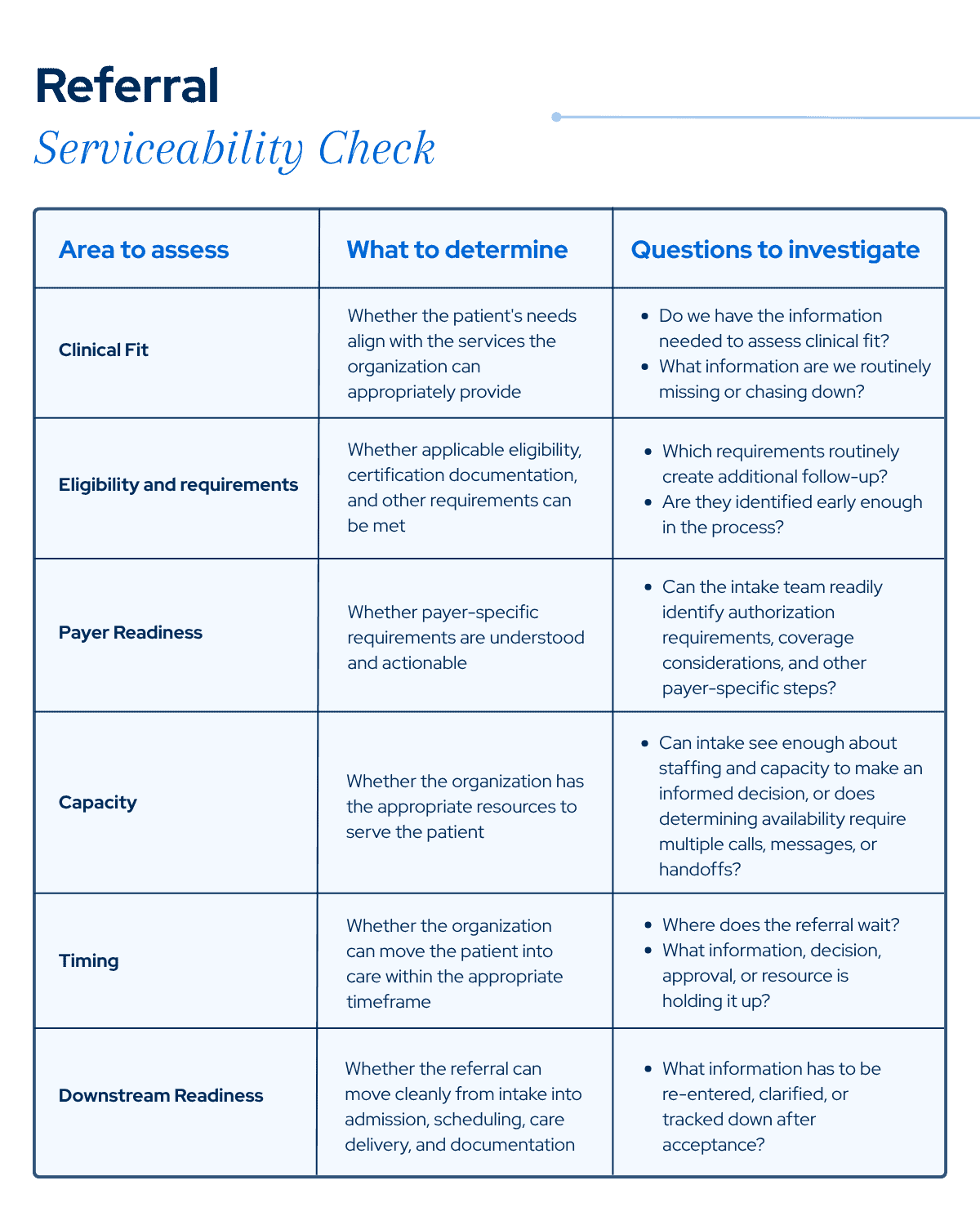
The objective isn’t to create a score that automatically determines whether a referral should be accepted. Clinical judgment, patient needs, payer requirements, organizational priorities, and other considerations remain a central part of the decision.
Instead, look for patterns. If the same payer requirements repeatedly slow intake, that’s a workflow issue worth investigating. If determining available capacity requires several manual handoffs, there may be a visibility problem. If information routinely has to be re-entered after acceptance, the front-end process may be creating work downstream.
A high-performing referral process doesn’t simply move referrals faster. It helps the organization understand what is required to serve patients before avoidable friction travels further into the operation.
Home health: Payer complexity changes the referral equation
For home health agencies, Medicare Advantage growth and broader payer complexity can add significant operational considerations to referral management. Authorization requirements can vary, approval timelines can differ, and payer-specific processes can create administrative work before and during an episode of care.
Those requirements are largely outside an agency’s control. The workflow used to manage them is not.
Referral growth adds administrative burden if intake employees have to search for payer requirements, manually track authorization status, or repeatedly follow up to determine what is needed. Unfortunately, hiring new intake personnel to cover an influx in referrals is not always a viable option. That makes payer readiness an important part of the serviceability conversation.
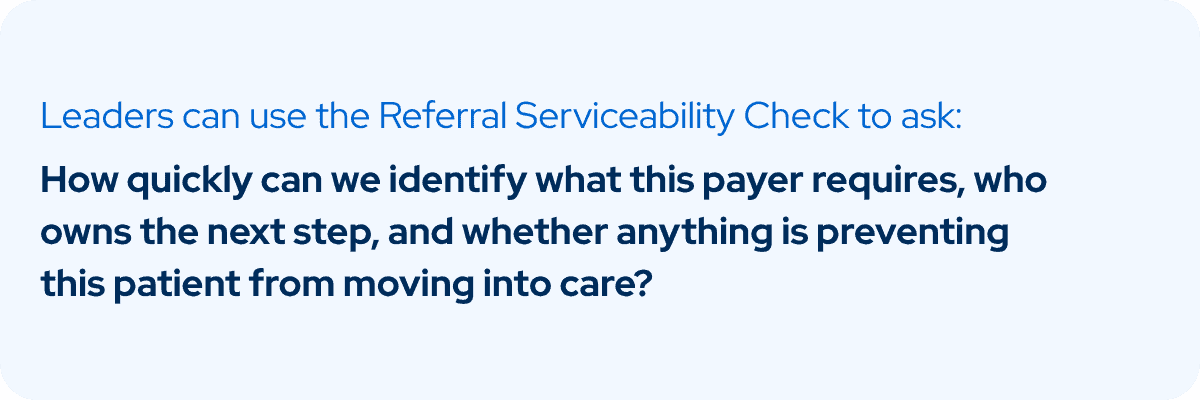
Timely access to appropriate home health care can support care transitions and help reduce the risk of avoidable healthcare utilization, including ED visits and hospital readmissions. But the intake process has to support appropriate, timely care rather than allow administrative complexity to become a source of delay.
Hospice: Serviceability starts with a hospice-specific intake process
Hospice referrals bring a distinct set of operational requirements. Determining eligibility, completing certification and recertification requirements, including CTI documentation, managing election documentation, and coordinating admission timing all shape how a patient moves from referral to care.
Here, consistency is particularly important. If different branches or employees handle the same requirements differently, variation at intake can create additional follow-up, documentation work, and compliance risk later.
For hospice leaders, the Referral Serviceability Check can help identify where that variation begins:
- Are eligibility requirements being evaluated consistently?
- Is required documentation readily available?
- Are missing items identified early?
- Can the team see what still needs to happen before admission, and who is responsible for it?
The goal is to make the operational steps surrounding intake decisions more visible and consistent.
Don’t let intake become a routing department
There is a difference between moving a referral and managing a referral.
When intake is highly manual, much of the team’s time can be spent routing information: receiving a referral, finding missing data, forwarding information, checking status, contacting another department, entering data somewhere else, and following up again.
That activity may keep work moving, but it doesn’t necessarily give the organization better visibility into why referrals stall, why they become non-admits, or where administrative effort is increasing.
This is where technology should do more than digitize the referral queue.
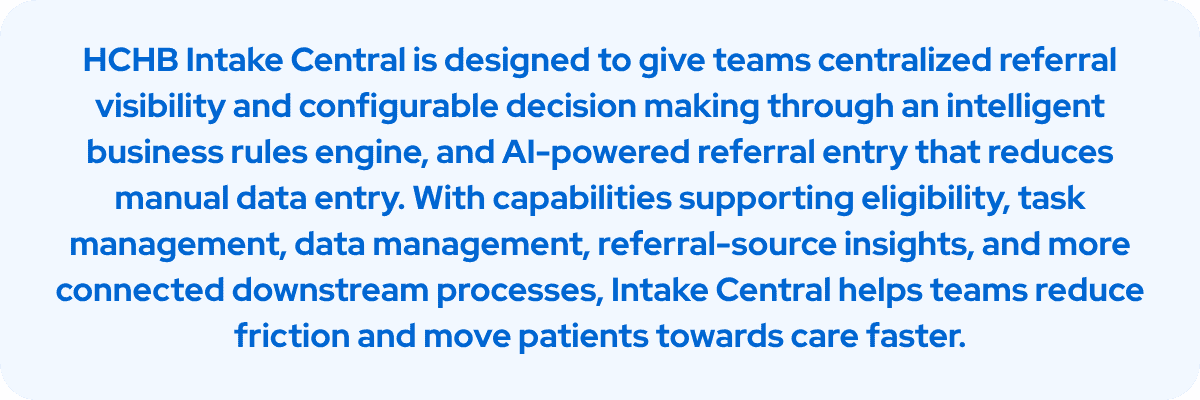
Instead of relying as heavily on employees to remember what comes next, track down status, or move information manually between steps, Intake Central can support a more structured intake process.
That doesn’t mean Intake Central decides which referrals an agency should accept. The value is in giving the organization better information and workflow support so its people can make those decisions and move appropriate referrals forward more efficiently.
Capacity needs to enter the conversation before scheduling
An accepted referral eventually becomes a patient who needs care. If capacity only becomes visible after intake hands the patient to scheduling, the organization may discover constraints too late in the process.
That doesn’t mean agencies should accept referrals only when the schedule looks easy. Workforce shortages are real, schedules change, and patient needs vary. But intake decisions are stronger when teams have a clearer understanding of the resources required to serve new patients.
A connected intake process can help reduce the distance between “We received a referral” and “We understand what it will take to serve this patient.”
That connection is also why referral management shouldn’t be treated as an isolated front-office function. Intake decisions affect scheduling, clinical workloads, documentation, authorization management, billing readiness, and ultimately the organization’s ability to grow without creating disproportionate administrative work downstream.
Look beyond conversion rate
Referral conversion is useful, but by itself it doesn’t explain whether the referral process is working well.
Consider looking at the operational story surrounding conversion:
- Why are referrals becoming non-admits?
- Where do referrals spend the most time waiting?
- Which payer requirements generate the most manual follow-up?
- How much work is required to determine whether the organization can staff a referral?
- Which missing information repeatedly delays admission?
- Where is information being entered or verified more than once?
- What work created during intake follows the patient into scheduling, clinical operations, or billing?
Those questions can reveal something a top-line conversion percentage cannot: what it costs operationally to turn referral demand into care.
That information can also help leaders distinguish between a demand problem and an execution problem. An organization may have strong referral demand but limited ability to process, evaluate, and operationalize that demand efficiently. Adding more referrals doesn’t resolve the constraint.
Better referral management connects the front door to the rest of the operation
Intake Central is most valuable when referral management isn’t treated as a standalone activity. The referral is the beginning of a workflow that eventually touches scheduling, care delivery, documentation, clinical operations, and reimbursement.
HCHB’s purpose-built EHR solutions for home health and hospice can provide the operating foundation for their respective service lines, while Intake Central extends that connected approach to the front end of the patient journey. The objective is a clearer path from referral to care, with less dependence on manual routing, individual memory, and disconnected information.
For an organization considering change, that makes intake a useful place to start. Look at how much effort it takes today to answer basic questions about a referral, determine what needs to happen next, and understand whether the organization is prepared to serve the patient. Those are current operating costs, even if the team has become very good at working around them.
Your next step: Put 10 referrals through the Serviceability Check
Start with 10 recent referrals. Choose a mix: accepted patients, non-admits, different payers, straightforward referrals, and referrals that required more work than expected.
Run each through the Referral Serviceability Check and document:
- What information was available when the referral arrived?
- What additional information did the team have to obtain?
- Which payer, eligibility, or documentation requirements had to be addressed?
- How did the team determine whether appropriate capacity was available?
- Where was the referral delayed?
- Did the referral require manual follow-up?
- What information or work had to be carried into another department after acceptance?
Then look across all 10. If the same friction appears repeatedly, you have identified a workflow that may be adding administrative effort every time the organization tries to grow. Healthy growth is about building an operating model that can turn appropriate referrals into care without making every additional patient disproportionately harder to serve.
See what a more connected front door could look like
If your Referral Serviceability Check uncovers manual handoffs, limited visibility, or recurring friction between referral and admission, HCHB can help you explore how Intake Central could support a more connected approach to referral management.