
Why Change Now: Measure Clinical Capacity, Not Just Headcount
When workforce is tight, headcount is one of the first numbers leaders watch. How many clinicians do we have? How many positions are open? How many more do we need? Those numbers are important, but they don’t tell you how much of your existing clinical capacity is actually available to deliver care.
A clinician’s workday includes more than patient visits. Documentation, travel, schedule changes, administrative requirements, and rework all require time. Some of that work is essential. Some may be reducible. And some may signal a genuine need for additional staff. Understanding the difference gives leaders a more useful view of workforce capacity.

Headcount and Usable Clinical Capacity Answer Different Questions
Headcount tells you how many clinicians are employed. Usable clinical capacity tells you more about how those clinical resources are being deployed. While recruiting addresses a shortage of people signaled by headcount, workflow improvements can address how clinical time is being used.
But when clinicians are difficult to recruit and retain, leaders have good reason to understand how much of their current workforce’s time is reaching patient care and how much is being consumed elsewhere.
The Clinical Capacity Audit
The Clinical Capacity Audit gives leadership a practical way to build that picture. Start small. Choose one branch, team, or discipline, and look at a representative period of work. The goal is simply to account for the major demands on clinical time.
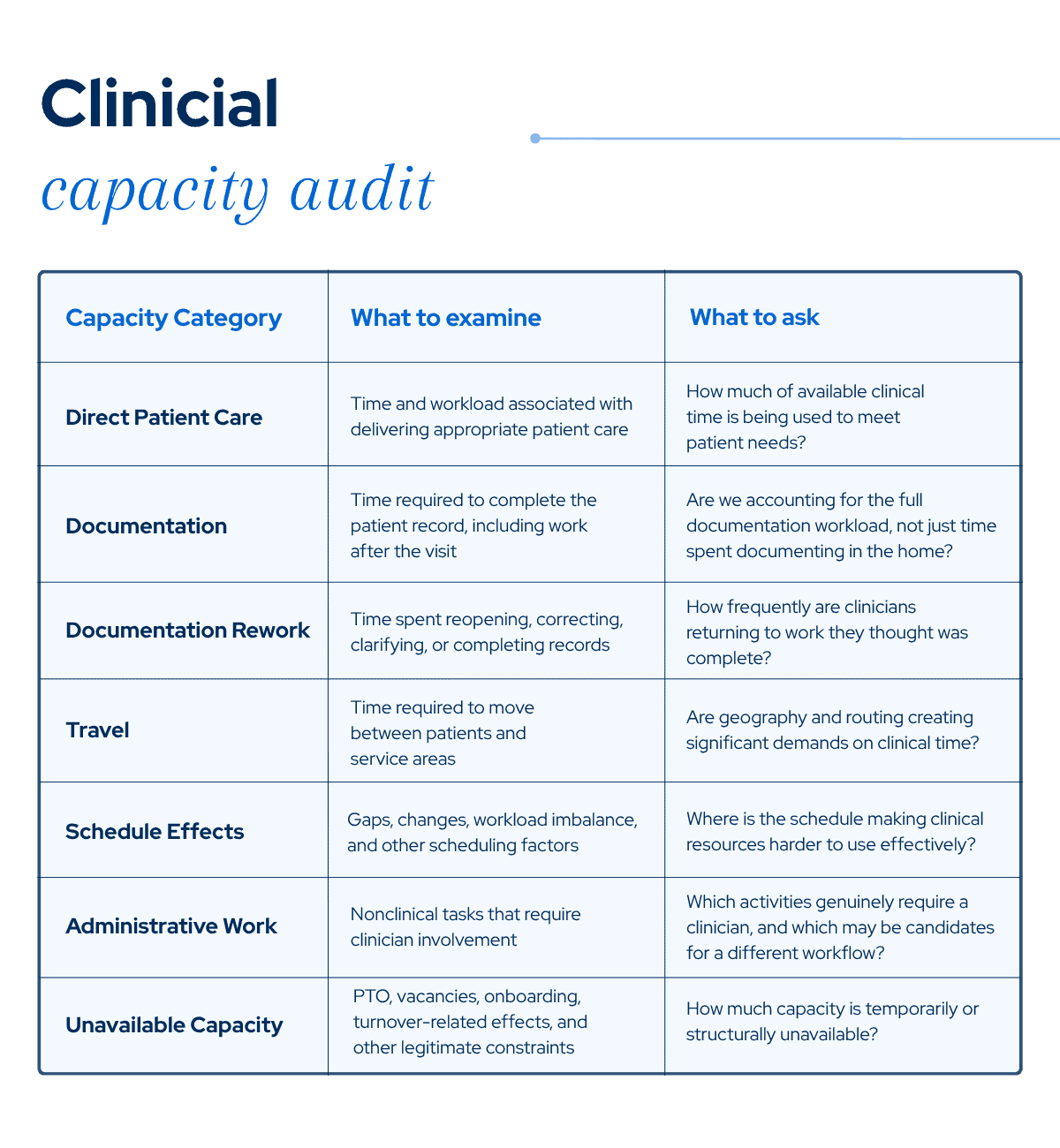
Don’t assign a target percentage to each category. Appropriate capacity will vary based on discipline, patient needs, geography, service line, and the way the organization delivers care. The useful output is a capacity profile: a clearer picture of where clinical resources are going.
From there, leadership can separate three very different conditions:
Three Conditions to Separate
- Necessary clinical work. Time appropriately required to deliver, coordinate, and document quality care.
- Potentially reducible work. Rework, unnecessary manual effort, inefficient handoffs, or other processes that may be consuming more clinical time than necessary.
- Capacity the organization genuinely doesn’t have. Demand that cannot appropriately be met with the clinical resources available.
The audit isn’t designed to make the staffing shortage look smaller. It is designed to make the capacity picture more accurate.
Don’t Measure Documentation Time Too Narrowly
Documentation deserves particular attention in a capacity audit because the initial time spent documenting may not represent its full impact on a clinician’s day. A clinician might complete documentation relatively quickly during or immediately after a visit. If the record later requires clarification or correction, however, the clinician has to return to it. A clinical manager may review the record, identify an issue, communicate with the clinician, review the revision, and potentially repeat part of that process.
A preventable correction can therefore consume clinical capacity more than once: first during clinical review and again when the field clinician returns to the record.
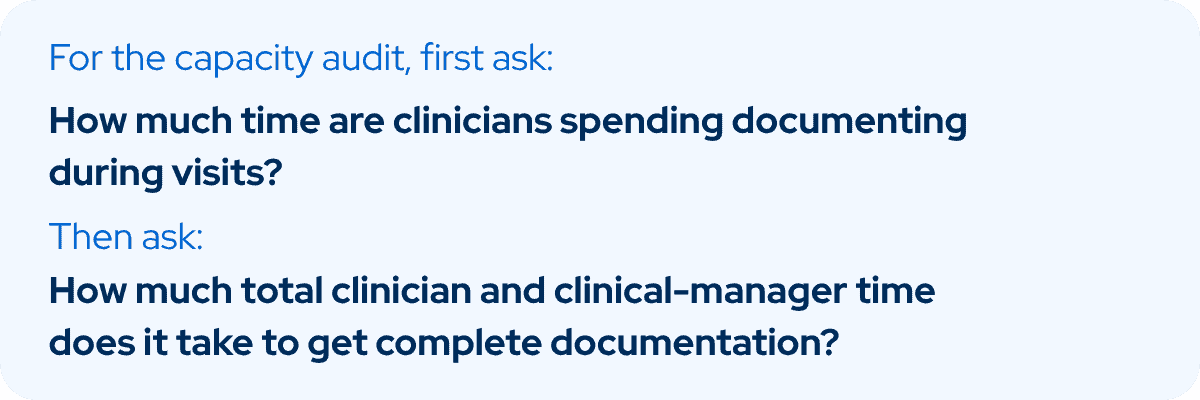
The goal is high-quality documentation completed as efficiently as possible, with fewer unnecessary revisions. Clinical review remains an important part of oversight. The opportunity is to reduce preventable back-and-forth so field clinicians and clinical managers can spend less time repeatedly addressing the same issues.
For the purposes of the capacity audit, the important point is simply to count the whole workload.
Travel Is Capacity, Too
Travel is an unavoidable part of home-based care. Treating all travel time as inefficiency would ignore the realities of serving patients where they live. But that doesn’t mean leaders should leave it out of the capacity picture.
Two clinicians with similar caseloads can face very different demands depending on geography, patient location, service area, and how their schedules are constructed. A rural branch may operate under very different travel constraints than a dense metropolitan market. The capacity audit should make those realities visible rather than treating clinicians as interchangeable units of labor.
Look at travel alongside the schedule:
- Are clinicians repeatedly crossing large parts of a service area?
- Are assignments requiring more travel than expected?
- Are frequent schedule changes creating additional movement?
- Are there geographic realities that simply have to be accounted for when determining how many patients a team can appropriately serve?
Stop treating time spent traveling as though it doesn’t affect available capacity.
A Schedule Can Look Full Without Telling You Much About Capacity
A calendar can show who is assigned where. It doesn’t necessarily tell leadership how difficult that schedule was to build or how well it reflects the realities of the workforce. Clinician availability, geography, patient preferences, continuity, workload, and changing patient needs all affect scheduling decisions.
For agencies relying heavily on manual scheduling, balancing those factors can require significant administrative effort. For agencies already using scheduling technology, the question is whether the information and capabilities available are helping teams make those decisions efficiently.
This is where HCHB Smart Scheduling can support the capacity conversation. It is designed to account for factors such as clinician availability, geography and travel, patient preferences, continuity, and workload when supporting scheduling decisions. Smart Scheduling can’t supply clinicians an agency doesn’t have, but it can help teams make more informed scheduling decisions with the clinical resources that are available.
Home Health: Capacity Is More Than Visits per Clinician
For home health leaders, it can be tempting to reduce capacity to a productivity number: clinicians, visits, and caseload. Those measures are useful, but the operating environment around them also affects what a team can reasonably deliver.
Start-of-care requirements, visit patterns, geography, documentation, schedule changes, clinical review, payer requirements, and administrative work can all place demands on clinical resources. A capacity audit gives leaders a way to look behind the aggregate number.
If one branch appears to have lower usable capacity than another, the immediate conclusion shouldn’t be that its clinicians need to do more. Examine what is different about the work. Geography may be different. Patient needs may be different. Vacancies may be affecting workload distribution. Documentation rework or administrative requirements may be consuming additional time.
Some of those conditions may be improvable. Others may simply need to be incorporated into workforce planning. The value is knowing which is which.
Hospice: Capacity Has to Reflect the Hospice Care Model
Hospice requires its own capacity lens. Patient needs can change, staffing intensity can vary, and care is delivered through an interdisciplinary model. Eligibility, certification documentation, care coordination, and other hospice-specific requirements also contribute to the work required to serve patients appropriately.
That makes a simple headcount-to-census comparison incomplete.
Hospice leaders can use the Clinical Capacity Audit to examine where clinical time is being used across direct care, travel, documentation, interdisciplinary work, administrative requirements, and other demands specific to the organization.
Your EHR Should Help Make Capacity Easier to See
Running the Clinical Capacity Audit once can uncover useful information. Managing capacity continuously requires better visibility into the work itself. HCHB provides purpose-built EHR solutions for home health and hospice, supporting the clinical and operational workflows at the center of their respective service lines. The broader operating model can also include capabilities such as Smart Scheduling for scheduling and capacity management and Curate: Scribe for clinician-controlled documentation support.
Make the Sources of Capacity Visible
Technology has the potential to help establish processes, but it can also be used to give leaders visibility to understand why capacity looks the way it does.
Can you distinguish a staffing shortage from a workflow problem? Can you see when geography is materially affecting a team’s capacity? Can you identify where documentation rework is consuming clinician and clinical-manager time? Can scheduling teams make decisions with enough information about availability, workload, and location? Those insights shape more informed workforce decisions.
Run the Audit Before Your Next Capacity Discussion
Choose one team, branch, or discipline. Don’t make the first audit an enterprise project.
For a Representative Period
- Account for the major categories consuming clinical capacity.
- Include work performed outside the patient’s home, particularly documentation and rework.
- Separate necessary clinical work from work that may be reducible.
- Identify capacity that is genuinely unavailable because of vacancies, PTO, onboarding, or other constraints.
- Review the findings with clinical and operational leaders before deciding what they mean.
The answer may be more clinicians, operational improvements, or both. When clinical resources are scarce, understanding how existing capacity is being used helps leaders make better decisions about where to recruit, where to improve workflows, and where both are necessary.
Get a Clearer View of Your Clinical Capacity
If your Clinical Capacity Audit raises questions about scheduling, clinical workflows, documentation, or visibility into how your workforce is being used, HCHB can help you explore how a more connected operating model could support your teams.