
Why Change Now: Stop Treating Documentation Rework as Just a Documentation Problem
Completing documentation doesn’t mark the end of the documentation process. If clinical review identifies missing, unclear, or insufficient information, the record goes back to the field clinician. The clinician then has to return to the chart, recall the details of the encounter, make the necessary updates, and send it back again for another review.
Documentation rework quickly becomes a clinical capacity problem as the same rework notes get sent back repeatedly across teams. It’s easy to underestimate this problem when organizations measure only how long clinicians spend documenting the first time.
Measure the full documentation cycle
Documentation efficiency can’t be measured only by how quickly a clinician completes the initial record. A relatively short documentation time during or immediately after a visit may be followed by additional work later. If clinical review identifies missing or insufficient information, the clinician may need to reopen the record, reconstruct details from the encounter, make revisions, and send it back for another review. Some of that work may happen after hours.
Preventable documentation correction consumes clinical capacity more than once because the clinical manager is also spending time on the same record: identifying the issue, communicating with the clinician, reviewing the correction, and potentially repeating the process.
Looking only at initial documentation time can make an inefficient process appear efficient. A better measure is the total work required to produce a complete, high-quality record:
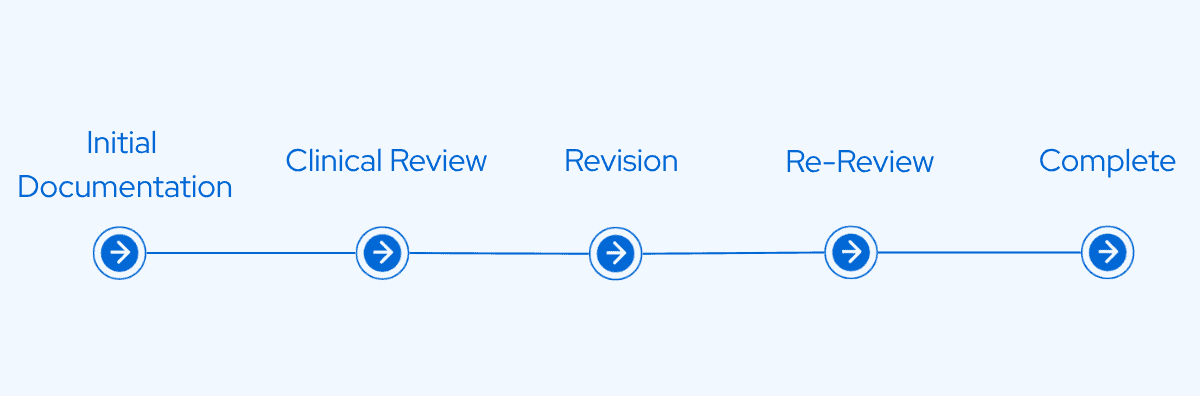
This doesn’t mean clinicians should spend more time documenting during every visit, nor should the goal be eliminating clinical review. The objective is to help clinicians complete high-quality documentation as efficiently as possible, with fewer unnecessary revisions and less back-and-forth.
The Documentation Rework Diagnostic
You don’t need to analyze every record to get a useful picture of rework. Start with a sample of records that required follow-up after clinical review. For each one, reconstruct what happened from the clinician’s initial documentation through completion.
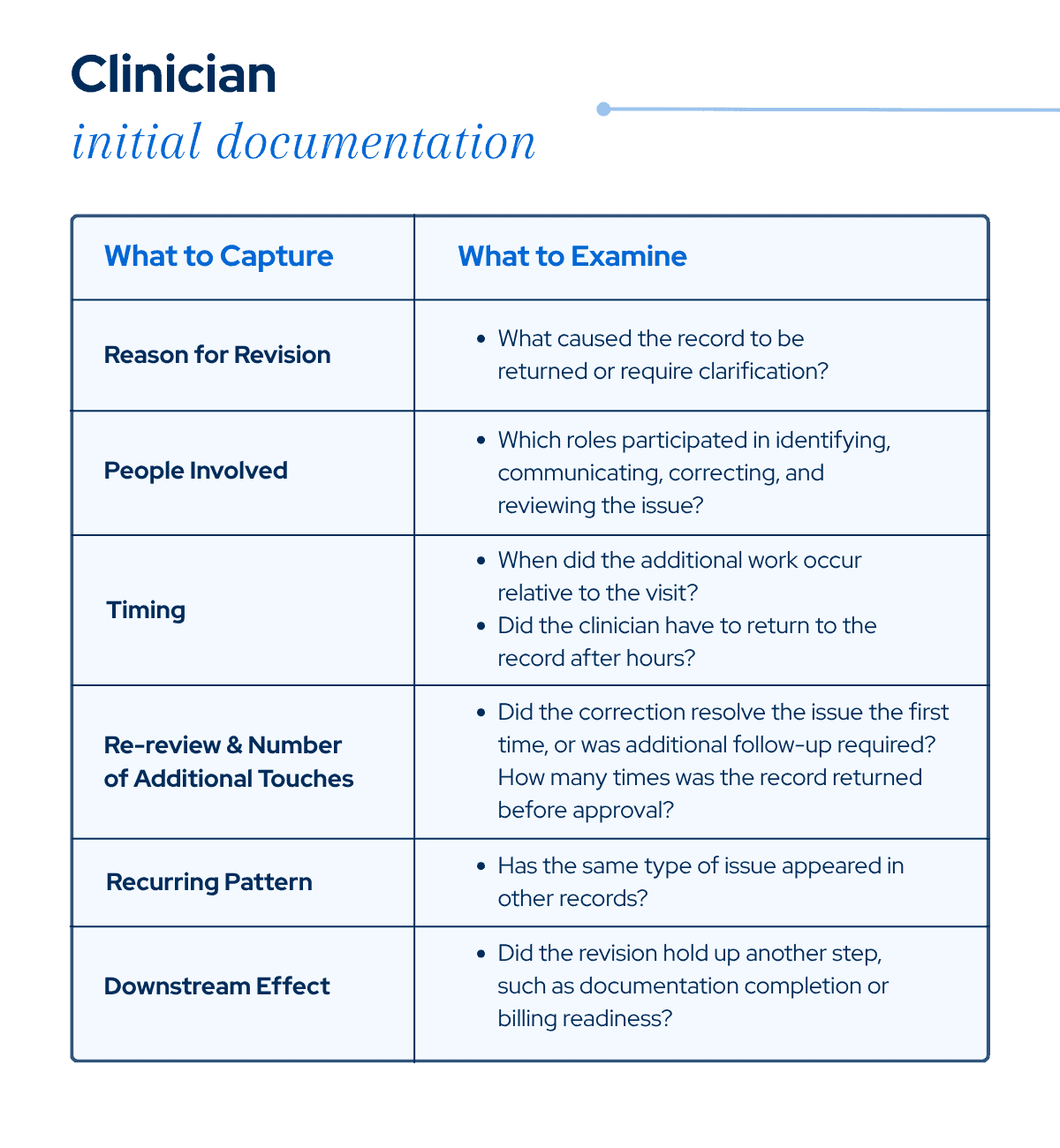
Clinical review exists for a reason. Some records will appropriately require clarification or additional documentation. Focus instead on preventable, recurring rework. Look for ways to better support clinicians so they can complete the documentation correctly the first time?
That support could take different forms depending on the issue:
- Clearer workflow guidance
- More consistent processes
- Better access to required information or training
- Point-of-care documentation tools that help capture necessary details
Don’t overlook the clinical manager’s workload
Documentation burden discussions tend to focus on the field clinician, and for good reason. After-hours documentation and administrative demands can consume time that clinicians would otherwise have available for patients or their personal lives. But rework also creates a second workload that can be less visible: clinical-manager time.
If the same types of issues recur across a team, experienced clinical resources can spend significant portions of their day managing correction cycles rather than applying their expertise to other work that requires clinical oversight and judgment.
Reducing preventable rework gives time back on both sides. Field clinicians spend less time reopening records and reconstructing details after the fact, while clinical managers spend less time repeatedly identifying and following up on documentation issues. The goal isn’t less clinical oversight. It’s to make that oversight more valuable.
Rework can affect more than the individual record
Documentation has to support the clinical story of the care being delivered, including applicable skilled-care and medical-necessity requirements. Documentation quality also intersects with clinical review and billing readiness.
For home health leaders, the diagnostic can help answer questions such as:
- Are the same issues recurring across clinicians, teams, or branches?
- How much clinician and clinical-manager involvement does each correction require?
- Are documentation corrections affecting downstream readiness?
Those findings can help distinguish isolated clinical corrections from recurring workflow patterns that deserve broader attention.
Better technology should reduce the documentation cycle, not just digitize it
Once you’ve identified recurring rework, technology becomes part of the conversation. Technology can be used to help clinicians produce a complete record efficiently and avoid unnecessary cycles of correction.
HCHB’s home health and hospice EHR solutions are designed around the workflows of their respective care settings, providing structure and guidance within the documentation process. That foundation can help organizations create more consistent workflows and maintain visibility as documentation moves toward completion. But documentation technology is also evolving beyond traditional forms and screens.
Curate: Scribe, embedded in Care+, uses ambient documentation to help clinicians capture information from the patient encounter and develop a draft for the clinician to review. It remains clinician controlled. Consent is required, and the clinician reviews, edits, and approves the documentation before it is finalized. The value proposition test is whether documentation technology can help clinicians complete high-quality records with less friction. That includes what happens after the initial documentation is completed.
Measure the cycle, not just the task
For your first Documentation Rework Diagnostic, pull a manageable sample, perhaps 10 to 20 records that required follow-up after clinical review.
Then trace each record through the full cycle:
- Identify why the record required follow-up. Group similar correction types together so recurring patterns become visible.
- Count the additional touches. Include the field clinician, clinical manager, and anyone else involved in getting the record to completion.
- Look at when the work happened. Pay particular attention to work performed significantly after the visit or after normal working hours.
- Identify repeat patterns. Determine which correction types are generating repeated work across multiple records.
- Choose one recurring source of rework to address. Consider whether workflow guidance, standardization, training, documentation technology, or another operational change could reduce the need for repeated correction. Don’t use the exercise to set a goal of zero revisions. That’s neither realistic nor necessarily desirable. Use it to understand how much clinical effort is going into avoidable repetition.
Reduce the work behind the documentation
If your Documentation Rework Diagnostic reveals recurring correction cycles, after-hours revisions, or significant clinical-manager follow-up, HCHB can help you explore how more connected documentation workflows and clinician-controlled technology can support a more efficient path to a complete record.