
Growth changes more than volume. As a home-based care organization expands across patients, clinicians, locations, payers, and service areas, it also has more decisions, workflows, and operating differences to coordinate.
Some of that complexity is expected. Different markets, payers, patient populations, and service lines may require different approaches. But growth can also magnify variation that was easier to manage when teams were smaller and leaders were closer to day-to-day operations.
As organizations grow, branches may develop different approaches to the same processes, and operational decisions can become increasingly dependent on the knowledge of individual team members. These variations can make it harder for leaders to determine whether differences in performance reflect legitimate local conditions or inconsistent execution. For example, a team may develop workarounds based on local knowledge or scheduling decisions may hinge on one person’s familiarity with the team members’ day-to-day lives.
At a smaller scale, experienced people can often compensate for these differences. As the organization expands, relying on individual knowledge and informal processes becomes harder to replicate consistently. A scalable operating model provides enough structure to support consistent execution and visibility while preserving the flexibility needed for legitimate differences across teams, markets, payers, and service lines.
Run the Scalability Stress Test
You don’t need to wait for the next acquisition, branch opening, or period of census growth to find out how your operating model will respond. Choose a realistic growth scenario and ask how today’s processes would perform under greater volume and complexity.
For example, consider what would happen if your organization experienced meaningful growth in patient volume, expanded into additional locations, or added clinicians and referral sources. Then assess five dimensions of the operating model.
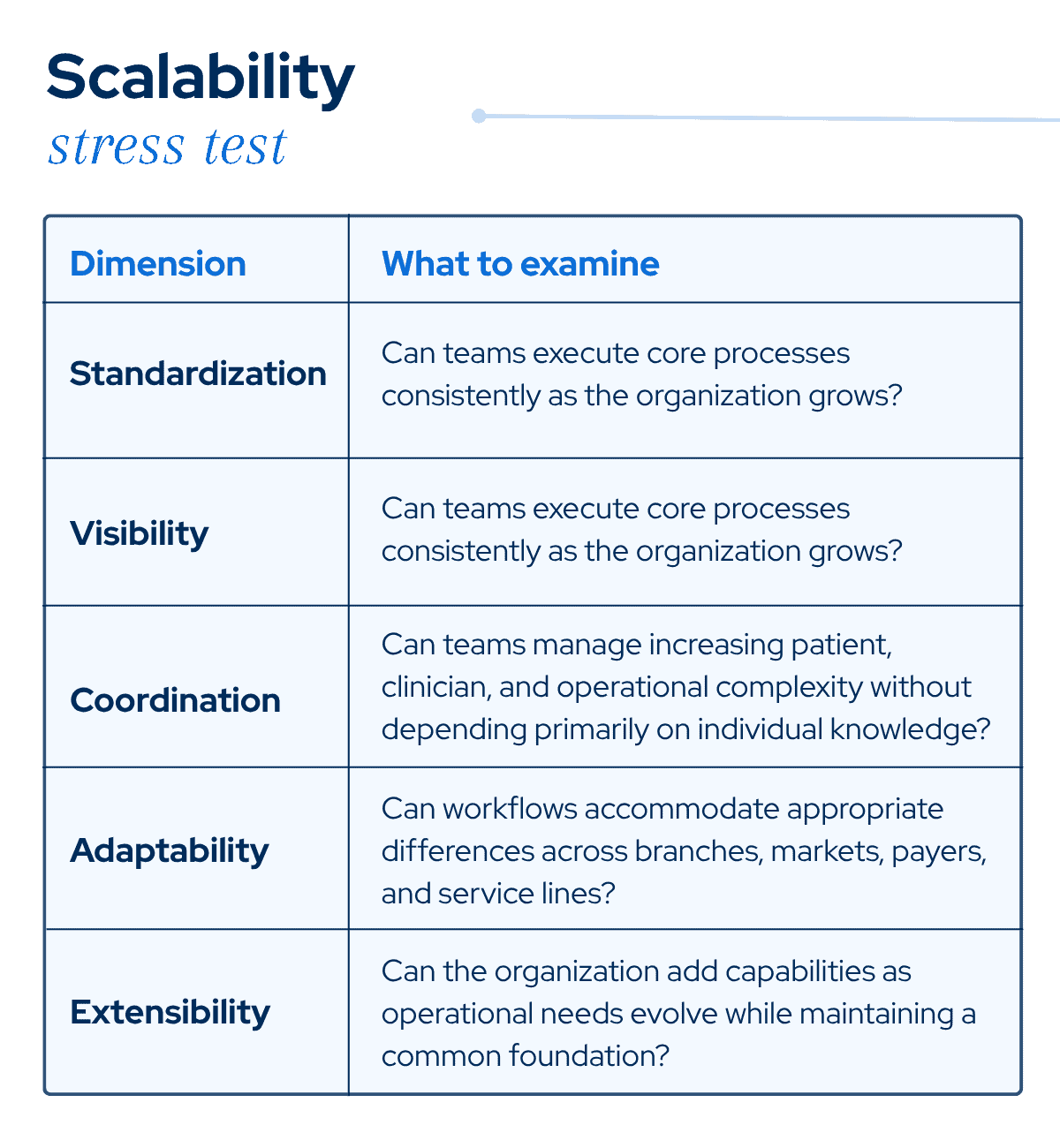
For each dimension, rate the organization:
- Ready: The current operating model should support the anticipated growth with manageable adjustments.
- Needs attention: Growth is likely to expose recurring challenges, but the organization has a clear path to address them.
- Priority: The current approach may become difficult to maintain as volume or complexity increases.
Don’t combine the ratings into a single score. The purpose is to identify which dimension deserves attention before the organization enters its next stage of growth.
Start with standardization, but don’t confuse it with sameness
Standardization is one of the first places to look because growth increases the number of people executing the same core processes. Referral intake, scheduling, documentation, clinical review, and billing readiness all involve decisions that may occur hundreds or thousands of times across an organization.
As the number of people involved increases, unnecessary variation can become harder to manage. That doesn’t mean every branch, payer, clinician, or patient should be handled identically. Home-based care requires flexibility because payer requirements, markets, and patient needs differ.
The goal is to distinguish necessary variation from avoidable variation to ensure the highest quality care is provided to all patients. Ask teams which variations are intentional and necessary, and which have emerged over time as people developed their own approaches to the same process. This information can help leaders decide where greater consistency would make growth easier to manage without imposing uniformity where flexibility is appropriate.
Test whether visibility can keep pace with complexity
Growth also changes what leaders need to see. When an organization is smaller, leaders may be able to stay close to individual teams and quickly understand why something is happening. As operations expand across more people, locations, and workflows, that level of direct knowledge becomes harder to maintain. The Scalability Stress Test should examine whether leaders can maintain useful operational visibility as complexity increases.
Consider:
- Can leaders understand performance across locations while still seeing meaningful differences?
- Can teams identify emerging operational issues before they become persistent problems?
- Can managers distinguish isolated exceptions from recurring patterns?
- Can leaders compare how core processes are performing across the organization?
- Can teams access the information they need to make operational decisions without relying primarily on institutional knowledge?
Visibility doesn’t require that every metric lives on a single screen. It means leaders have access to enough reliable information to understand how the operating model is performing and where attention may be needed.
Determine whether coordination depends too heavily on individual knowledge
Experienced employees are an enormous asset in home-based care. But there is a scalability risk when the process itself depends on a particular employee knowing what should happen next. For example, a scheduler may understand the nuances of a territory from years of experience, or an intake employee may know which requirements apply to a particular payer. That expertise should inform the operating model, not become the only way it functions.
As part of the stress test, identify processes where successful execution depends heavily on specific people knowing how to navigate them. Then ask whether the organization has enough workflow structure, information, and shared process to make that knowledge easier to apply consistently as teams grow.
Preserve the flexibility growth requires
Standardization alone doesn’t create scalability. As organizations enter new markets, work with different payers, or operate across multiple service lines, they may encounter legitimate differences in requirements and operations. An operating model that is too rigid can become just as difficult to scale as one with too little structure. That’s why adaptability belongs in the Scalability Stress Test. Consider whether the organization can accommodate appropriate variation without creating an entirely separate way of operating every time something changes.
For example:
- Can teams adjust to payer-specific requirements while maintaining a recognizable intake process?
- Can different locations respond to local operating realities while working from a common foundation?
- Can leaders introduce process changes across the organization without rebuilding workflows from scratch?
Test the model against your next stage of growth
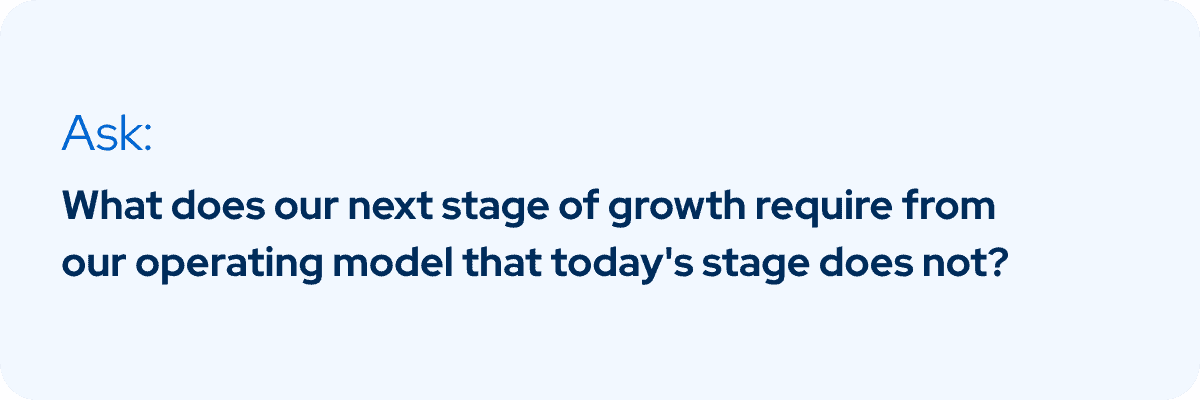
Once you’ve assessed the five dimensions, apply them to a realistic growth scenario. Imagine the organization 12 to 24 months from now. You may have higher census, additional locations, more clinicians, new payer relationships, or greater operational complexity. Walk through the stress test again.
- Standardization: Where would greater volume make inconsistent execution harder to manage?
- Visibility: What would leaders need to understand across a larger operation?
- Coordination: Which processes would become difficult if they continued to depend primarily on individual knowledge?
- Adaptability: Where would growth introduce legitimate new requirements or operating differences?
- Extensibility: What additional capabilities might the organization need as those requirements evolve?
Identify where today’s operating model may need to mature before greater complexity arrives.
A common operating foundation becomes more important as you grow
Technology’s role changes as organizations become more complex. As the organization grows, maintaining a common operational foundation becomes increasingly valuable. For example, Homecare Homebase provides an EHR foundation that is separated by service line to support the distinct workflows required for home health and hospice care, while providing a cohesive platform.
A purpose-built EHR can help organizations establish repeatable workflows, support consistent execution, and give teams a shared operational environment as the number of patients, clinicians, locations, and decisions increases. The value of that foundation extends beyond maintaining the clinical record. Back Office and PointCare users can easily navigate work within each service line and, if needed, leadership can view vital analytics for both service lines within a single dashboard. That common foundation can also provide a starting point for the next stage of operational maturity.
Extend the foundation as complexity increases
Scalability doesn’t require every organization to deploy every capability at once. The technology an agency needs at one stage of growth may differ from what it needs after expanding into additional markets, increasing census, or managing more operational complexity. For organizations operating on HCHB, additional capabilities can extend the core platform where evolving needs warrant them.
Intake Central is designed to give teams centralized referral visibility, configurable decision making through an intelligent business rules engine, and AI-powered referral entry that reduces manual data entry. With capabilities supporting eligibility, task management, data management, referral-source insights, and more connected downstream processes, Intake Central helps teams reduce friction and move patients toward care faster.
Smart Scheduling can support increasingly complex scheduling operations through automation that considers factors such as clinician availability, workload, geography, patient preferences, and continuity.
Curate: Scribe can add clinician-controlled ambient documentation assistance, helping address documentation friction while keeping clinicians responsible for reviewing and approving the final record.
These capabilities solve different problems at different points in the operating model and extend an established foundation where increasing organizational complexity creates a clear need.
Scalability looks different at different stages of maturity
The Scalability Stress Test may lead organizations to different priorities. An agency relying on disconnected systems or highly variable processes may first need a stronger core foundation and greater consistency across essential workflows.
An organization already operating on HCHB may discover that its foundation remains strong, but increasing complexity in a particular area creates an opportunity to extend technology use. There isn’t one technology maturity model every organization needs to follow.
Revisit the stress test before each major stage of growth
Scalability isn’t something an organization solves once. The Scalability Stress Test is useful as a recurring management exercise. Before a major expansion, acquisition, technology investment, or period of anticipated growth, revisit the five dimensions:
Standardization. Visibility. Coordination. Adaptability. Extensibility.
Identify where the existing model is ready, where manageable adjustments are needed, and where greater attention is warranted before complexity increases. Then choose the area that matters most for the next stage of growth.
Build for complexity before complexity arrives
A scalable operating model doesn’t eliminate the complexity of home-based care. It gives the organization a stronger way to manage it. As agencies grow, the challenge is to maintain enough consistency to operate effectively, enough visibility to understand performance, enough coordination to support larger teams, and enough flexibility to respond to legitimate differences across patients, payers, markets, and service lines.
Technology can support that model by providing a common operational foundation and allowing organizations to extend it as their needs evolve. The result is an organization better prepared for the future.
Build a foundation that can grow with your organization
Explore how HCHB provides a purpose-built foundation for home-based care and capabilities that can extend that foundation as operational needs evolve.