
Why Change Now: Find the Next Workflow Your Agency Should Fix
Most agencies already know where they have opportunities to improve. What agencies need is a practical way to decide where to focus first. Trying to tackle everything at once can turn operational improvement into a long list of projects competing for the same people, time, and resources.
This approach creates a repeatable way to make meaningful operational change without waiting for the perfect time, a bigger team, or a multiyear transformation plan.
The 30-Day Operating Model Review
The 30-Day Operating Model Review moves a leadership team through four stages:
Choose → Baseline → Change → Evaluate
At the end of 30 days, you should have made a focused change, gathered evidence about what happened, and made a decision about what to do next.
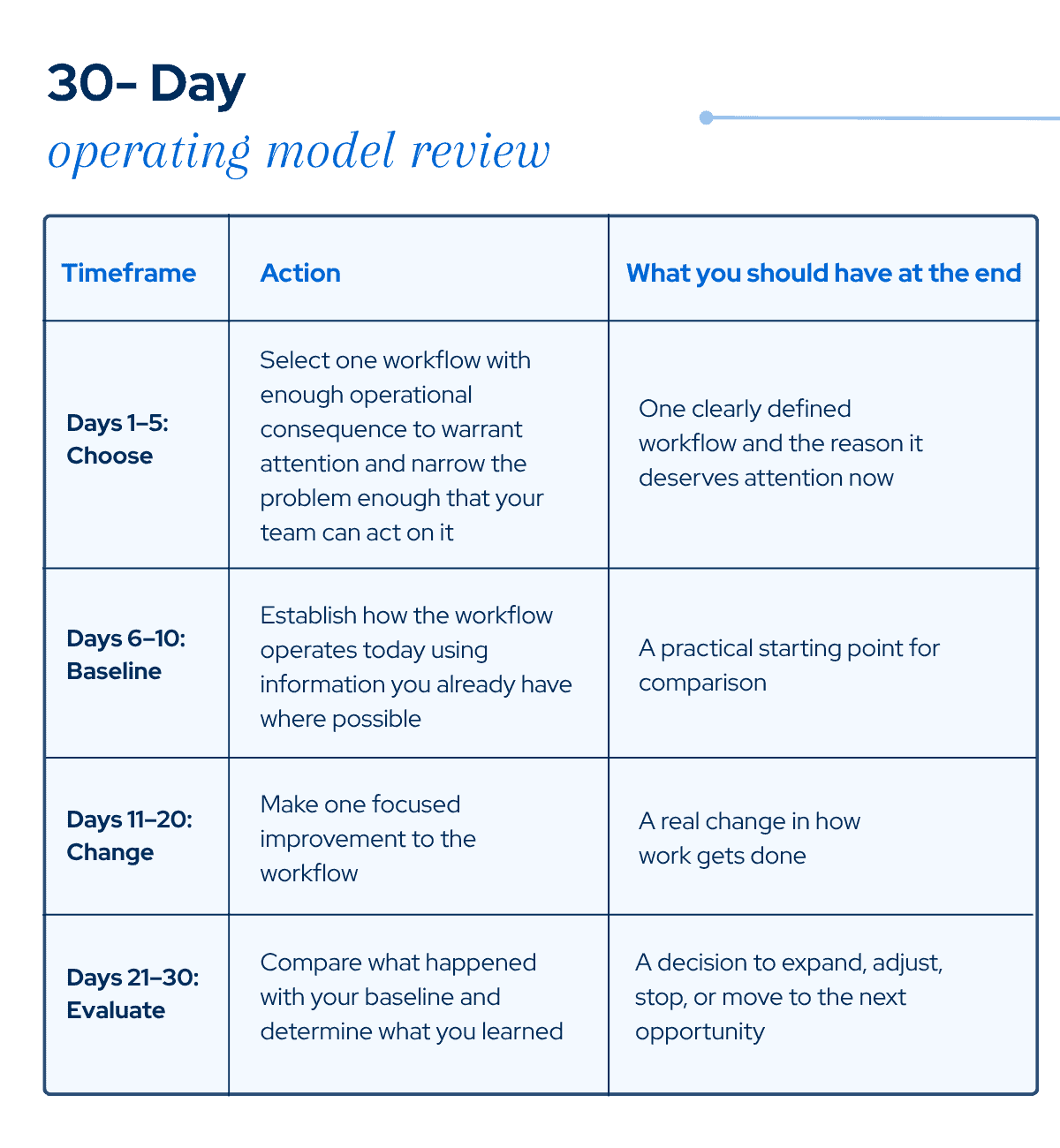
The exercise is intentionally small at the start. A 30-day review of one workflow is much more manageable than a mandate to “modernize operations,” and it forces the team to prioritize.
Days 1–5: Choose something worth changing
The first five days aren’t for cataloging every problem in the organization. They’re for selecting one. Start with the issues your teams already know about. Maybe intake spends too much time chasing information, schedulers repeatedly intervene in assignments, or clinicians are reopening records after review. You don’t need another exhaustive assessment to prove those issues exist.
Instead, use four filters to determine which one deserves the next 30 days:
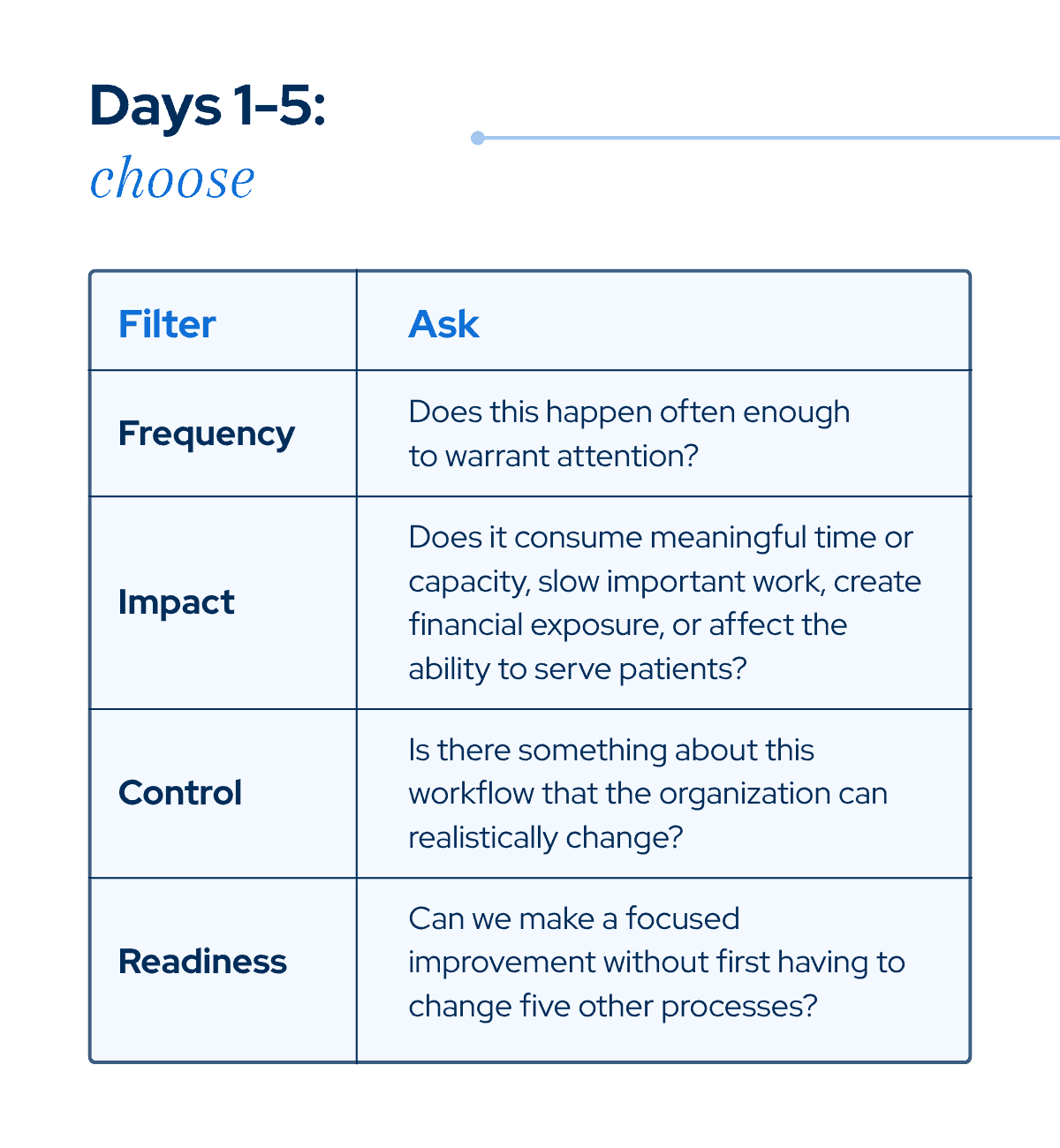
You don’t have to answer whether your organization is “ready for transformation.” You only need to determine whether you’re ready to improve this workflow.
Once you’ve chosen a workflow, define it narrowly. “Fix documentation” isn’t a 30-day project. “Reduce the back-and-forth required when a specific type of documentation issue reaches clinical review” is something a team can examine and act on.
“Improve scheduling” is broad. “Reduce the amount of manual intervention required to build the next day’s schedules” gives the team something concrete to work with. Specificity makes the next 25 days useful.
Days 6–10: Establish a baseline you can actually use
You don’t need a new analytics project before you can improve a workflow. Use the information already available to establish a practical baseline. Depending on the workflow, that could include:
- Time required to complete the work
- Number of manual touches or handoffs
- Work sitting in a queue
- Exceptions requiring intervention
- Documentation sent back for revision
- After-hours work
- Duplicate entry
- Records waiting to become billing-ready
- Staff time spent tracking status or obtaining missing information
Don’t measure something simply because it’s easy to count. Choose measures that tell you whether the workflow is becoming easier, more consistent, or less resource-intensive.
For example, a documentation project shouldn’t focus only on how long a clinician initially spends documenting. A short documentation time can mask additional time spent later reopening the record, making revisions, and going back and forth with clinical review. A more useful baseline would account for the total work required to produce a complete, high-quality record.
The same principle applies elsewhere. A fast referral response isn’t necessarily an efficient intake process if employees spend substantial time manually gathering information afterward. Your baseline should reflect the work you actually want to improve.
Days 11–20: Change the workflow
Make a change. The appropriate change will depend on the workflow. A team might remove an unnecessary handoff, clarify ownership, standardize how a task is completed, change when information is collected, improve access to information, automate a routine step, or use an existing technology capability differently. Keep the scope controlled enough that you can observe what happens.
For example:
Intake: Instead of redesigning the entire referral process, standardize how the team identifies and manages a recurring payer requirement.
Scheduling: Instead of trying to solve the organization’s workforce shortage, reduce a specific source of repetitive manual scheduling work.
Documentation: Instead of targeting documentation time alone, change the workflow around a recurring source of revision and evaluate whether it reduces total rework for both field clinicians and clinical managers.
Billing readiness: Instead of trying to accelerate the entire revenue cycle, address one recurring upstream requirement that regularly holds records from moving forward.
The objective isn’t to produce a dramatic result in 10 days. It’s to see whether a specific operational change makes the work better.
Days 21–30: Decide what happens next
The final stage is not about declaring the project a success or failure. Compare the changed workflow with your baseline. Talk to the people doing the work. Look for unintended consequences as well as improvements.
Ask:
- Did the change reduce the work we were targeting?
- Did it make the workflow easier or more consistent for the people using it?
- Did we move work somewhere else rather than remove it?
- Did anything downstream improve or become more difficult?
- What would need to change before we expanded this approach?
Then make a decision.
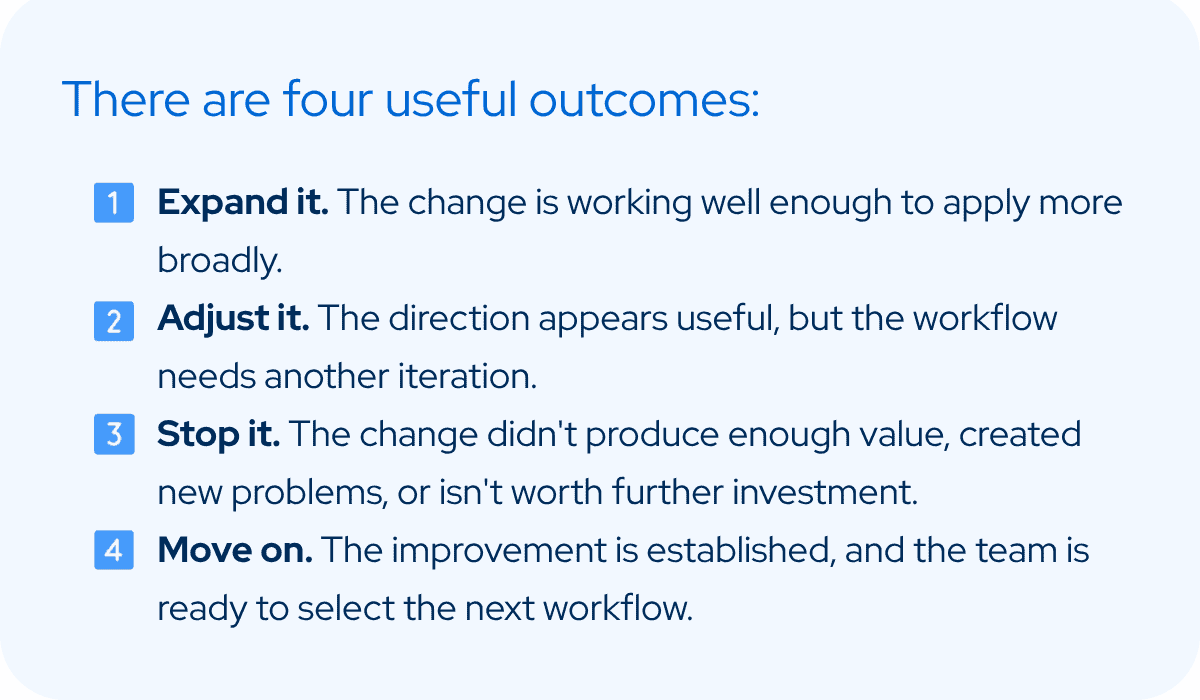
Stopping something can be just as valuable as expanding it. A disciplined operating model should help leaders learn quickly enough to avoid institutionalizing changes that don’t improve the work.
Use the review to test your technology, too
Not every workflow problem requires new technology. But once you’ve identified a change worth making, your technology should make it easier to sustain. Ask whether your current systems can help standardize the improved workflow, reduce repetitive manual steps, provide the information people need when they need it, support the next handoff, and give leaders enough visibility to see whether the change is holding.
HCHB gives home health and hospice organizations a connected technology foundation for putting operational improvements into practice and sustaining them as the organization evolves. From that foundation, capabilities such as Intake Central, Smart Scheduling, and Curate: Scribe can support specific areas where an agency has identified an opportunity to improve.
The opportunity depends on where the agency is today:
- If referral and intake work is the priority, Intake Central is designed to support centralized referral visibility, configurable workflows, eligibility support, task management, referral-source intelligence, and more connected downstream processes.
- If scheduling is consuming significant administrative effort, Smart Scheduling can support decisions involving clinician availability, geography and travel, patient preferences, continuity, and workload while reducing routine manual scheduling work.
- If documentation rework is consuming field clinician and clinical manager time, Curate: Scribe brings clinician-controlled ambient documentation assistance into the care workflow. The clinician remains responsible for reviewing, editing, and approving the documentation.
For an agency already using HCHB, the next improvement may come from extending an existing foundation into a workflow that still requires significant manual effort. For an organization considering a new EHR, the review can help clarify what the future operating foundation needs to support.
The point is to know which operational problem you’re asking it to solve and choose the appropriate technology solution.
Day 30 should lead somewhere
A 30-day review ends with a decision. If the change worked, decide where to extend it. If it needs adjustment, run another focused iteration. If it didn’t improve the workflow, stop investing in it and use what you learned. If the improvement is established, choose the next workflow.
Then start the clock again for another 30-day cycle. This cadence can be particularly valuable for organizations that have delayed operational changes because modernization feels too large, too expensive, or too disruptive to tackle all at once.
You don’t need to change everything to start building a more scalable operating model. Choose one workflow. Establish the baseline. Make a focused change. Evaluate it. Then decide what’s next.
Over time, the question shifts from “When will we be ready to change?” to “Which workflow are we improving next?”
Bring us the workflow
If your 30-Day Operating Model Review identifies a workflow that is consuming too much time, creating unnecessary manual work, or becoming harder to sustain as your organization grows, HCHB can help you explore what a more connected approach could look like.