
Artificial intelligence is rapidly reshaping healthcare, but AI in home-based care presents a unique set of challenges that many early solutions underestimated.
For provider executives and clinical leaders, the conversation has shifted. It is no longer about whether AI has potential, it is about whether that potential can translate into real-world impact in home health and hospice environments.
As adoption accelerates, one reality is becoming clear: success with AI in home-based care depends less on model capability and more on how well it aligns with clinical workflows, regulatory requirements, and the realities of care delivery in the home.
The promise of AI and where it meets reality
Early momentum around AI focused on a compelling value proposition: reduce administrative burden and give clinicians more time with patients.
That message resonated across the industry, especially as organizations faced:
- Rising patient acuity
- Workforce shortages
- Increasing documentation requirements
AI showed early promise in several areas:
- Reducing documentation time
- Accelerating start-of-care workflows
- Supporting earlier identification of hospitalization risk
However, moving from pilot programs to real-world adoption has exposed deeper home care technology challenges, particularly in environments where care is delivered outside controlled clinical settings.
Alex Milani, MD/MBA, CEO of StenoHealth explained the perspective shift required to develop AI for home-based care:
“To be honest, even though I trained as a physician, I did not initially appreciate how complex home-based care really is. I understood that patients were referred to home health and somehow improved, but I did not understand the documentation burden, the field realities, or how much judgment is required in the home.
Once I spent time understanding the day-to-day lives of these clinicians, the chaotic environments they work in, and the documentation requirements they carry, I was immediately drawn to the space. These are some of the hardest-working and least-recognized clinicians in healthcare. They are incredibly important today, and they are only going to become more important as demographics shift and more care moves into the home.”
Why home-based care is fundamentally different
Many AI solutions were initially designed for hospitals or clinics, environments that are structured, controlled, and supported by consistent infrastructure.
Home-based care operates under a completely different set of conditions. The challenge is not just variability, it’s compounded variability across environment, workflow, data, and human interaction.
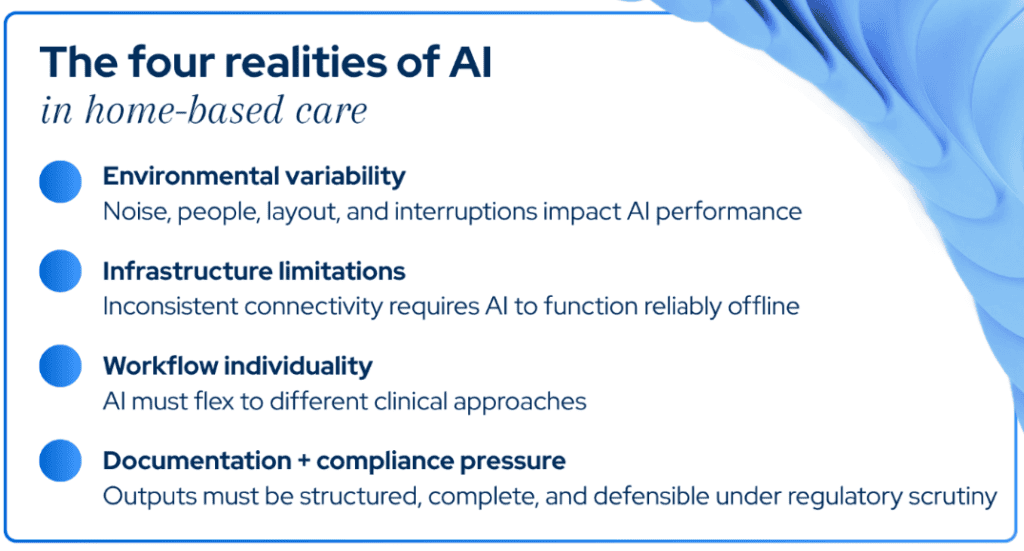
The environment is uncontrolled and constantly changing
Every visit takes place in a new setting, with new variables:
- Background noise from televisions, conversations, or pets
- Multiple people speaking at once (patients, caregivers, family members)
- Limited physical space or poor lighting (affecting image capture quality)
- Interruptions that shift the flow of the visit
These factors directly impact AI performance, especially for ambient documentation tools that rely on audio capture and contextual understanding.
Connectivity is not guaranteed
Unlike hospital settings, home-based care operates with:
- Intermittent cellular coverage
- Limited or unreliable Wi-Fi
- Offline documentation requirements
AI tools that assume constant connectivity can fail at critical moments, especially during start-of-care visits where timing, completeness, and accuracy directly impact reimbursement and care planning.
Workflows are individualized
In home-based care, there is no single “correct” way to conduct a visit.
Clinicians adapt in real time based on:
- Patient condition and acuity
- Home environment and caregiver involvement
- Time constraints and travel schedules
- Personal clinical style
As Milani notes:
“This is not plug-and-play, every clinician practices a little differently. The clinician has to learn how to speak to the system, how to guide it, and how to navigate it naturally during a real visit. The lesson for us was that adoption is not just about model quality. It is also about trust, training, and workflow design.”
This creates a fundamental requirement: AI must adapt to the clinician, not the other way around.
Documentation inputs are fragmented and inconsistent
Home-based care documentation is assembled from multiple, often unstructured sources:
- Referral documents
- Prior visit notes
- Medication lists from external systems
- Verbal input from patients and caregivers
AI must reconcile, structure, and validate this information in real time, while maintaining compliance with strict documentation standards.
Privacy and security risks are amplified in the home
Ambient AI introduces a new layer of complexity in shared living environments.
Unlike clinical settings:
- Family members may overhear sensitive discussions
- Multiple voices may be captured unintentionally
- AI systems may ingest information not intended for the medical record
This raises critical questions:
- How is consent handled when others are present?
- How does the system distinguish between speakers?
- What controls ensure only appropriate information is documented?
Without clear governance and clinician control, these scenarios can introduce HIPAA exposure and erode patient trust.
Transition: from complexity to consequence
These realities don’t exist in isolation, they converge in one place: documentation.
In home-based care, documentation is where:
- Clinical decisions are recorded
- Compliance is validated
- Reimbursement is determined
- Risk is either mitigated or introduced
When AI struggles with environmental noise, fragmented inputs, or workflow variability, the impact shows up immediately in the medical record.
That’s why the next challenge is not just technical performance, it’s documentation integrity and risk.
Documentation: the highest-stakes challenge for AI
In home health and hospice, documentation is not just administrative, it directly impacts:
- Reimbursement
- Compliance with CMS Conditions of Participation
- Audit defensibility
- Quality reporting (including OASIS and evolving hospice frameworks like HOPE)
This raises the bar for AI significantly.
Generating fluent text is not enough. Documentation must be:
- Structured and complete
- Clinically specific
- Aligned with regulatory standards
Providers consistently highlight a key gap:
AI that creates narrative does not always produce compliant documentation.
With regulatory changes such as:
- Mandatory all-payer OASIS data collection (effective July 2025)
- ONC HTI-1 transparency requirements for predictive AI
- FDA guidance on clinical decision support
The expectation is clear: documentation must be accurate, auditable, and defensible regardless of how it is generated.
AI adoption requires behavior change
One of the most overlooked aspects of AI in home-based care is the level of behavioral change required.
Ambient AI tools, for example, capture what is spoken, not what is implied. This requires clinicians to:
- Verbalize clinical reasoning
- Clearly state risk and interventions
- Guide the AI during the visit
Clinicians have to learn how to speak to the system and how to guide it. This is not a minor adjustment. It represents one of the most significant workflow changes since the transition from paper to EHR.
Risk and compliance: why governance matters
As AI becomes embedded in care delivery, risk exposure increases.
Healthcare providers remain accountable for:
- Patient safety
- Documentation integrity
- Billing accuracy
- Data privacy
Even when AI tools are vendor-provided.
Key risks include:
- Incomplete or misleading documentation
- Incorrect clinical outputs
- HIPAA and data security exposure
- Reimbursement risk tied to documentation errors
Notably, the most common issues are not obvious failures. They are subtle:
- Missing details
- Plausible but incorrect statements
These can be difficult to detect but still create clinical and regulatory risk.
This reinforces the need for:
- Human-in-the-loop validation
- Transparent AI outputs
- Strong governance frameworks
The integration problem: why point solutions fall short
Another major barrier to success is fragmentation.
AI tools that operate outside the system of record often introduce:
- Duplicate workflows
- Data inconsistencies
- Limited visibility
- Increased operational risk
Providers consistently emphasize that success depends on integration, not standalone tools.
AI embedded within workflows can:
- Improve documentation quality at the point of care
- Support compliance in real time
- Enable earlier clinical insight
- Reduce administrative burden without shifting work downstream
This shift, from tools to embedded intelligence, is essential to utilize AI for care quality improvement.
A more realistic model for AI in home-based care
The future of AI in home-based care is not about automation replacing clinicians. It is about augmentation.
AI should not be used as an autopilot tool. It should be treated as a co-pilot, with humans as the decision-makers.
A more effective approach to AI includes:
- Embedded intelligence within existing workflows
- Transparent, explainable outputs
- Human oversight and control
- Alignment with real-world care environments
This model supports both operational efficiency and AI for care quality improvement, without compromising compliance or clinical integrity.
What this means for providers
Organizations seeing meaningful results with AI share a common approach.
They are not adopting the most tools. They are aligning AI with:
- Clinical workflows
- Documentation requirements
- Regulatory expectations
- Workforce realities
They are treating AI as infrastructure, not a feature. That distinction matters.
Because in home-based care, success is not measured by what AI can generate. It is measured by whether it:
- Reduces administrative burden
- Strengthens documentation quality
- Supports better clinical decisions
- Helps clinicians spend more time with patients and families
Download the full May AI report
This article highlights the key challenges shaping AI in home-based care, but it only scratches the surface.
For deeper insights into:
- Real-world adoption patterns
- Documentation and compliance considerations
- Risk exposure and governance strategies
- The role of embedded AI in improving care delivery
 Download the full May AI Report: AI in Clinical & Revenue Operations: A Responsible, Embedded Intelligence Strategy for…