
When home-based care organizations talk about workforce strategy, the conversation often centers on recruiting, retention, and engagement. Those are all important priorities that share one common challenge. They’re often focused on people after operational decisions have already been made.
Every clinician begins the day with the same objective: provide excellent patient care. What determines whether that day feels productive or frustrating isn’t usually motivation, commitment, or even workload alone. It’s how work is designed, information flows and decisions are made. Clinical leaders don’t always think about workflow in those terms because workflows are often viewed as operational processes.
For clinicians, workflow is the daily experience of delivering care. Organizations that intentionally improve workflow don’t simply become more efficient. They create an environment where clinicians can spend less time navigating systems and more time practicing at the top of their license.
Every workflow tells a story
Most operational workflows don’t become complicated overnight. They evolve over time as organizations respond to new regulations, changing reimbursement models, staffing shortages, technology implementations, and the day-to-day realities of delivering care. A documentation requirement is added to strengthen compliance, an additional approval step helps reduce errors, a spreadsheet fills an information gap, and a new communication process addresses an immediate operational challenge. Individually, each change makes sense. The problem is that few organizations stop to redesign the workflow as a whole, allowing complexity to accumulate until clinicians spend as much energy navigating the process as they do delivering care.
Over time, those additional steps become part of the organization’s normal way of working. Clinicians adapt by creating workarounds and completing documentation after hours because there isn’t enough time during patient visits. They rely on phone calls to bridge disconnected systems, and develop their own processes to keep care moving forward. Managers, in turn, spend more of their time resolving operational issues than coaching clinicians or improving care delivery.
None of these outcomes are typically the result of poor planning or inadequate leadership. They emerge gradually as well-intentioned process improvements accumulate without anyone stepping back to evaluate how the entire workflow functions from the clinician’s perspective. The result is an operating environment where experienced clinicians devote an increasing share of their time and mental energy to navigating the work rather than delivering it.
Improving the clinician experience isn’t about asking people to become more resilient. It’s about designing systems that require less resilience to navigate in the first place. The problem is when clinicians must devote more time and mental energy to navigating the work than delivering the care itself.
That’s why workflow deserves strategic attention. Every workflow reflects a series of leadership decisions about how work gets done. When those decisions simplify information flow, reduce unnecessary steps, and support clinicians in the moment they need information, the clinician experience improves naturally. In that sense, workflow isn’t simply an operational process. It’s one of the clearest expressions of an organization’s commitment to the people delivering care.
Download the workforce research
Improving clinician satisfaction begins with understanding the experiences shaping the workday.
Download What Clinicians Are Really Asking for and What It Means for Your Retention Strategy to explore HCHB’s workforce research and discover how leading home-based care organizations are identifying operational friction, improving clinician workflows, and building more sustainable care teams.
 What Clinicians Are Really Asking for and What It Means for Your Retention Strategy
Workflow improvement isn’t a technology project
One of the biggest misconceptions about workflow improvement is that it’s primarily an IT initiative. Technology can certainly support better workflows, but technology alone rarely fixes inefficient processes. It must be paired with input from the field and leadership alignment.
The most successful organizations begin with different questions:
- Where are clinicians losing unnecessary time?
- Which decisions could be simplified?
- Which administrative tasks don’t directly improve patient care?
- Which workarounds have quietly become standard practice?
- Only after answering those questions does technology become part of the solution.
A framework for evaluating workflow maturity
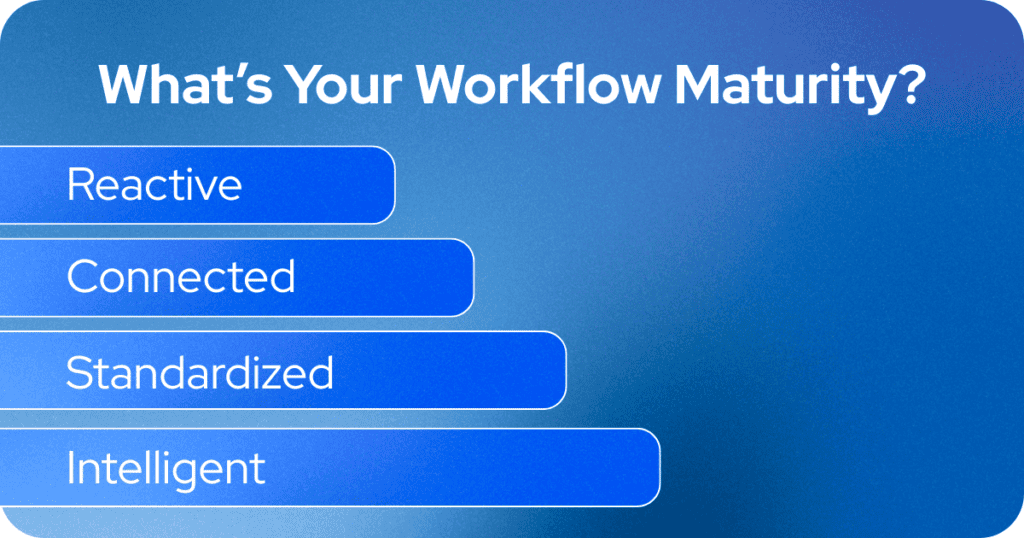
Improving workflow doesn’t require redesigning every process at once. In fact, the most successful organizations tend to improve incrementally, building workflows that become more proactive over time. Clinical leaders can use a simple workflow maturity model to assess where their organization is today and identify the next opportunity for improvement.
Level 1: Reactive
Work depends heavily on individual effort. Clinicians spend time searching for information, creating workarounds, and solving operational problems as they occur. Schedules change frequently, documentation happens after hours, and communication relies on multiple manual touchpoints.
Level 2: Standardized
Core workflows become more consistent. Documentation expectations are clear, communication processes are better defined, and operational variation begins to decrease. While administrative work remains significant, clinicians spend less time figuring out how work should happen.
Level 3: Connected
Information flows across the organization instead of remaining isolated within individual departments. Referral information, scheduling, documentation, and clinical management become more closely connected, reducing duplicate work and improving visibility for both field and office staff.
Level 4: Intelligent
Technology begins supporting operational decisions rather than simply recording them. Embedded intelligence helps organize information before clinicians need it, surfaces insights within existing workflows, and enables leaders to identify operational bottlenecks earlier. Instead of asking clinicians to manage technology, technology supports clinicians. Organizations don’t need to reach the highest level immediately. The goal is continuous improvement, removing one source of operational friction at a time.
The best workflows make great care easier
One of the most valuable questions a Clinical Director can ask is surprisingly simple:
“If we were designing this process today, would we build it this way?”
Many workflows exist because they solved yesterday’s problem. As organizations grow, regulations evolve, and technology advances, those same processes may introduce unnecessary complexity. Great workflow design challenges assumptions. Every improvement that removes unnecessary effort creates more capacity for patient care. That doesn’t mean every process should become faster. It means every process should become more purposeful.
Better workflows support better leadership
Workflow design isn’t solely about improving the clinician experience. It also changes how leaders lead. When workflows become more connected, managers spend less time reacting to operational issues and more time coaching clinicians, improving quality, and planning for future growth.
Instead of asking: “Why wasn’t this documentation completed?”
Leaders can ask: “What prevented documentation from fitting naturally into the clinician’s day?”
Instead of responding to burnout after it appears, leaders can identify workload imbalances, communication gaps, or inefficient processes before they become workforce challenges. The shift to proactive leadership is one of the greatest benefits of operational maturity. Technology supports this transition by providing leaders with greater visibility into documentation status, workload distribution, scheduling trends, and operational performance. Rather than replacing leadership judgment, these insights help managers identify patterns earlier and intervene more effectively.
Better workflows create better experiences
Optimal Home Care & Hospice experienced this firsthand after implementing Homecare Homebase.
By improving access to patient information and streamlining clinical workflows, clinicians spent less time searching for documentation and more time focused on developing personalized care plans. Operational improvements also supported greater consistency across care delivery while reducing unnecessary administrative effort. This story shows the value of workflow improvement for clinicians and the organization as a whole.
Workflow is a competitive advantage
The demand for home-based care continues to grow, while the competition for experienced clinicians remains intense. Organizations that view workflow as a strategic capability will be better positioned to attract, support, and retain talented clinicians.
According to the U.S. Bureau of Labor Statistics, employment of home health and personal care aides is projected to grow much faster than the average for all occupations over the coming decade, increasing the importance of creating work environments where clinicians can succeed.
For many organizations, the next competitive advantage won’t come from asking clinicians to work harder. It will come from making work easier. When workflow improves, clinician satisfaction, operational performance, and patient care improve together. That’s why workflow isn’t just an operational strategy. It’s a workforce strategy.