
Clinical leaders spend much of their day managing what can be measured including staffing levels, productivity, documentation time, visit completion, quality measures, and compliance. These metrics are essential for running a successful home-based care organization. They help leaders understand what’s happening across the agency and where operational attention is needed. But clinician experience, one of the strongest indicators of future organizational performance, rarely appears on a dashboard.
When workforce challenges are discussed, the conversation often begins with recruitment and ends with retention. By the time a clinician resigns, the experiences that influenced that decision have often built for months. Documentation takes longer than expected. Daily schedules become less predictable. Communication requires more follow-up and administrative tasks slowly consume more of the day than patient care.
Individually, these moments seem manageable. Collectively, they shape how clinicians experience their work. For Clinical Directors, recognizing those early signals creates an opportunity to improve operational performance, strengthen workforce stability, and ultimately deliver better patient care.
We measure performance. Clinicians experience the work.
Home-based care organizations have become increasingly sophisticated in measuring operational performance. Clinical leaders can quickly access dashboards that track quality outcomes, productivity, documentation completion, visit utilization, and regulatory compliance. These metrics help organizations identify trends and make informed operational decisions.
What they don’t always reveal is how work is experienced by the clinicians delivering care. A productivity report shows the number of completed visits. It doesn’t show how many unexpected schedule changes occurred throughout the day. Documentation reports confirm that records were completed. They don’t reveal whether documentation was finished during normal working hours or after clinicians returned home for the evening. Quality metrics measure outcomes. They don’t measure the mental effort required to achieve them.
Operational performance and clinician experience are closely connected. Organizations that focus exclusively on one without understanding the other may unintentionally create workflows that meet organizational goals while making clinicians’ jobs increasingly difficult. The question isn’t whether organizations should measure performance. It’s whether they’re also paying attention to the experiences shaping that performance.
The first warning sign isn’t burnout
Burnout has become one of healthcare’s most discussed workforce challenges. Yet burnout rarely appears overnight. More often, it develops through the accumulation of small operational frustrations that gradually increase stress and cognitive load.
Picture how these everyday experiences affect clinicians’ day to day:
- Preparing for tomorrow’s patients after dinner because there wasn’t enough time during the workday
- Spending extra time searching for referral information before a visit
- Re-entering information that already exists somewhere else
- Adjusting to another unexpected schedule change.
None of these experiences necessarily indicate that a clinician is about to leave. They do indicate that the work itself is harder than it needs to be. Research from the American Nurses Foundation’s Fifth Annual Mental Health and Wellness Survey shows that workplace stress and emotional exhaustion remain significant challenges across the nursing profession, reinforcing the importance of identifying operational issues before they contribute to long-term burnout.
For Clinical Directors, this shifts the leadership conversation. Instead of asking, “How do we reduce burnout?” A better question may be: “What operational conditions are creating unnecessary stress in the first place?”
Workflow is the clinician experience
Every handoff, documentation requirement, schedule change, duplicate entry, and communication delay shapes how clinicians experience caring for patients. While each step may seem minor on its own, together they determine whether a day feels productive or unnecessarily difficult. That’s why improving the clinician experience begins with examining workflows rather than engagement surveys.
Consider a typical start-of-care visit. Incomplete referral information, manual medication reconciliation and the extensive documentation required for regulatory compliance often extend data entry work well beyond the patient visit. Starts of Care also often prompt multiple follow up communication tasks through coordination notes, phone calls or emails. The clinician hasn’t simply completed a visit, they’ve managed a series of operational obstacles.
Now imagine removing just a few of those obstacles:
- Referral information is organized before the visit.
- Medication reconciliation is accelerated through embedded AI assistance.
- Documentation support is available within the existing workflow instead of after the visit.
- Clinical managers gain earlier visibility into workload trends before clinicians become overwhelmed.
None of these improvements change a clinician’s commitment to delivering excellent care. They change how much effort is required to deliver it. This philosophy increasingly guides HCHB’s approach to innovation. Rather than asking clinicians to adopt entirely new processes, new capabilities are embedded directly into everyday workflows. The goal is simple: reduce administrative effort while preserving clinician oversight, transparency, and clinical judgment.
For Clinical Directors, workflow design is no longer simply an operational responsibility. It’s one of the strongest drivers of the clinician experience.
Download the workforce research
Every organization wants to retain great clinicians. The first step is understanding how clinicians experience the work of delivering care.
Download What Clinicians Are Really Asking for and What It Means for Your Retention Strategy to explore HCHB’s latest workforce research and learn how leading home-based care organizations are identifying operational friction, strengthening clinician retention, and building more sustainable care teams.
 What Clinicians Are Really Asking for and What It Means for Your Retention Strategy
A simple way to evaluate the clinician experience
Improving the clinician experience doesn’t always require a major transformation initiative. Often, it starts by asking better questions. Clinical Directors can gain valuable operational insights by incorporating a simple clinician experience audit into quarterly leadership meetings, branch reviews, or one-on-one conversations with clinicians.
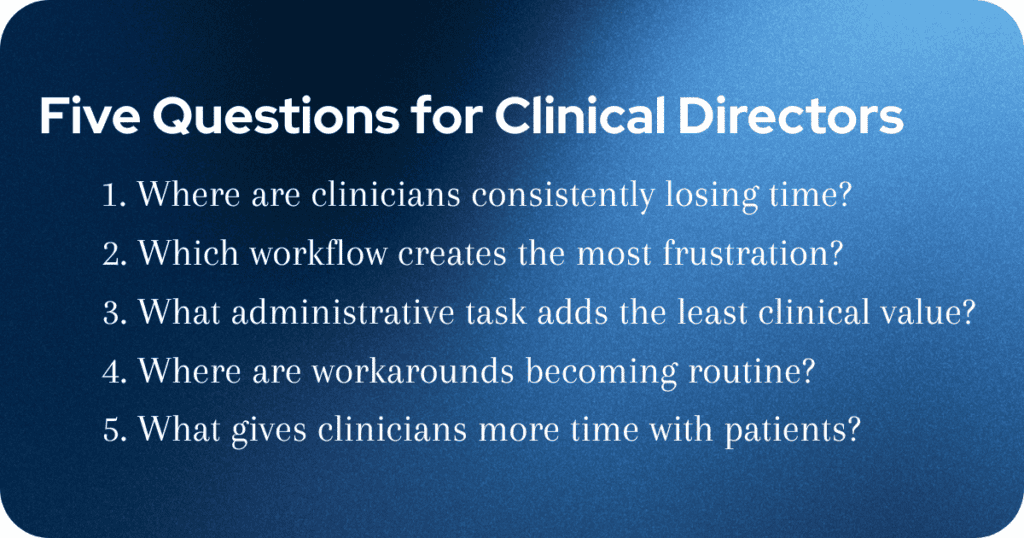
Instead of focusing solely on productivity metrics, consider these five questions:
1. Where are clinicians consistently losing time?
Look beyond visit counts and documentation completion rates. Identify repetitive administrative tasks, manual processes, or communication delays that consume time without directly improving patient care.
2. Which workflow creates the most frustration?
Every organization has one or two processes that clinicians quietly work around because “that’s the way we’ve always done it.” Those workarounds often identify the best opportunities for operational improvement.
3. What administrative task adds the least clinical value?
Documentation and compliance are essential, but many supporting tasks can be simplified, automated, or redesigned without compromising quality or regulatory requirements.
4. Where are workarounds becoming routine?
When clinicians consistently create their own solutions to operational problems, leaders should view those workarounds as valuable feedback. They’re often signs that a workflow needs attention rather than additional training.
5. What gives clinicians more time with patients?
This question keeps every improvement effort focused on its ultimate purpose. Operational excellence isn’t measured by how efficiently organizations complete administrative work. It’s measured by how effectively operations enable clinicians to provide exceptional care. These conversations won’t replace operational dashboards. They’ll help explain what the dashboards can’t.
Improving clinician experience starts with workflow
Recognition programs, appreciation events, wellness initiatives, and professional development all contribute to a positive workplace culture.
They’re important investments. but they can’t compensate for workflows that create unnecessary frustration every day. A clinician who routinely spends evenings completing documentation won’t feel less stressed because of an appreciation luncheon. A nurse navigating constant schedule changes won’t regain work-life balance through an occasional recognition award.
Daily work shapes the clinician experience far more than occasional events. That’s why many high-performing home-based care organizations begin workforce improvement efforts by examining operational design rather than employee engagement programs alone.
They ask questions such as:
- Can clinicians access complete patient information before every visit?
- Are documentation workflows intuitive and efficient?
- Can scheduling become more proactive and predictable?
- Are communication tools reducing or creating administrative work?
- Can routine administrative tasks be simplified while maintaining compliance?
These improvements don’t simply increase efficiency. They create a work environment where clinicians can spend more of their day focused on the reason they entered healthcare: caring for patients.
Better workflows create better experiences, and better care
Workflow improvements don’t benefit clinicians alone. They strengthen the entire care delivery process. One published HCHB customer story illustrates this well.
After implementing Homecare Homebase, Optimal Home Care & Hospice improved clinicians’ access to patient information, reducing time spent searching for documentation and enabling more personalized care planning. By streamlining workflows and improving information accessibility, the organization supported both operational efficiency and a better day-to-day experience for its clinical teams.
Technology doesn’t improve clinical experience because it’s innovative. It improves the clinician experience when it removes barriers between clinicians and patients. Whether that’s reducing documentation burden, improving workload visibility, streamlining medication reconciliation, or making information easier to access, every operational improvement creates more capacity for meaningful patient care.
The future of workforce strategy begins with clinician experience
Demand for home-based care will continue to increase as the population ages and more care shifts into the home while organizations compete for experienced clinicians. The organizations that succeed recognize that clinician experience is one of the earliest indicators of future organizational performance. By creating an environment where clinicians can focus less on navigating processes and more on caring for patients, leaders can improve retention, strengthen quality, build workforce resilience, and create the capacity to serve more patients with confidence.