
Why Change Now: Find Margin Leakage Before It Reaches the Financial Statement
Margin pressure is easy to see on a financial statement, but the forces behind it can come from many directions. Reimbursement changes, labor costs, payer requirements, and regulatory demands can all affect financial performance, and agencies have limited control over many of them.
Margin pressure and margin leakage are related, but they aren’t the same. Margin pressure reflects the broader financial forces affecting an agency. Margin leakage occurs when operational inefficiencies or breakdowns further erode financial performance. While agencies can’t eliminate every source of margin pressure, they can look for opportunities to reduce preventable leakage within their own operations.
That leakage can begin well before a claim reaches billing. Delays in intake, labor-intensive scheduling, documentation rework, and incomplete records can all add time and cost as care moves through the organization. Margin is the cumulative result of how work moves through your organization.
When these issues repeat across patients, clinicians, and branches, routine workflow friction becomes an operating-model problem. It consumes capacity, slows downstream work, and can add financial pressure that may only become visible later in reporting.
That’s why finding margin leakage requires looking upstream of the financial statement.
You may not control every reimbursement or payer change, but you can examine the friction within your operating model and determine where change could have the greatest impact. That’s where a Margin Leakage Map can help.
The Margin Leakage Map: Trace Friction Back to Its Source
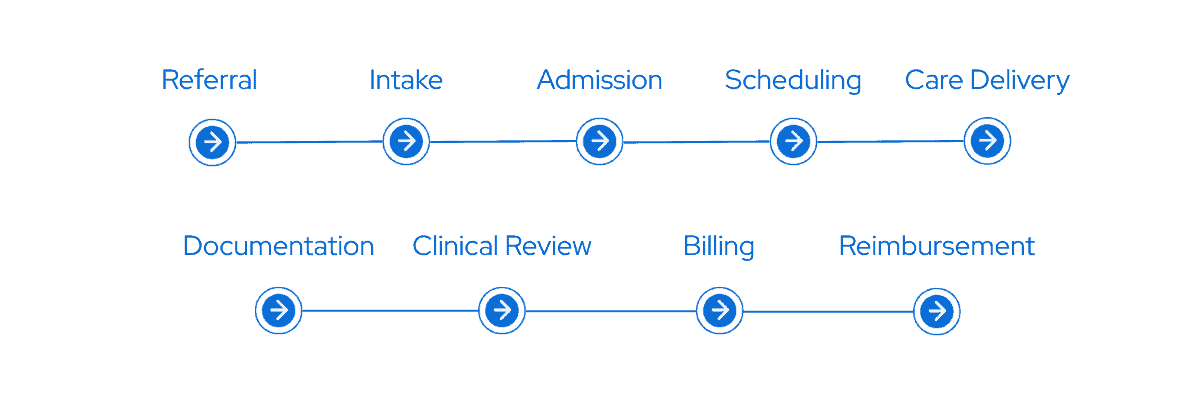
Choose a defined sample to review: one branch, one service line, one payer group or a recent group of patients. Then follow the work from referral through reimbursement.
At each stage, look for four forms of operational leakage.
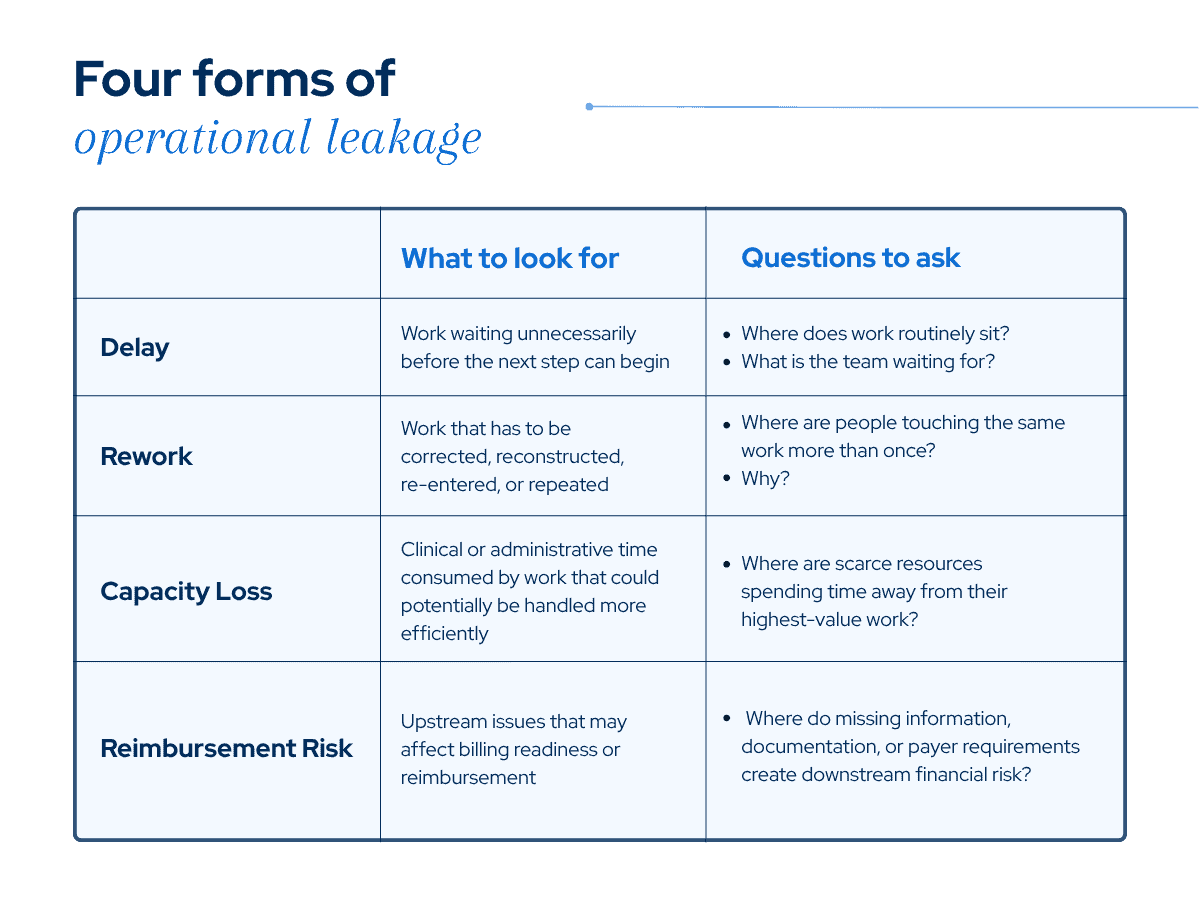
Apply the questions across the care-delivery lifecycle
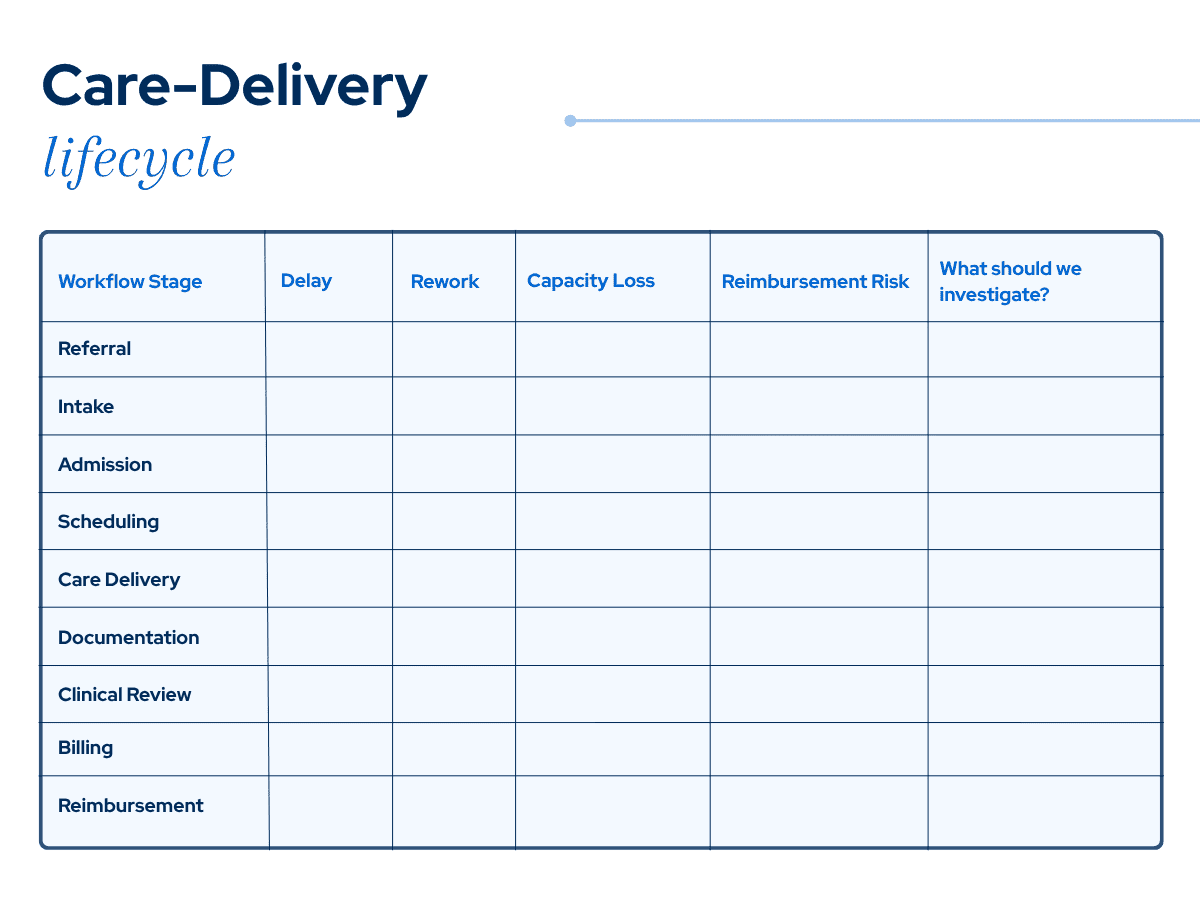
You don’t need to fill out every box. The objective is to find patterns and trace those patterns back to their source.
If clinical review repeatedly identifies the same documentation issue, for example, the question isn’t simply how to make the review queue move faster. Ask why that issue is reaching clinical review in the first place. Could better training, assessment formatting changes, OASIS/HOPE sequencing, or standardized forms reduce preventable rework?
If scheduling requires significant manual effort, identify what is consuming that time. Is the team manually matching clinicians and patients, accounting for geography and availability, balancing workloads or repeatedly rebuilding schedules? For agencies relying heavily on manual processes, that may reveal an opportunity for scheduling automation. If automation is already in place, frequent manual intervention may instead point to gaps in the information or workflow supporting it.
If billing is regularly waiting on incomplete records, don’t assume the billing department owns the problem. Trace the delay upstream. Is documentation incomplete? Is required information difficult to identify? Is the record moving through unnecessary handoffs before it’s ready to bill?
Locate the source before treating the symptom.
That principle also changes how leaders evaluate technology. The question isn’t simply whether a tool can make one task faster. It’s whether the technology can remove friction at its source without creating more work somewhere else.
Documentation Is a Good Example of How Hidden Leakage Compounds
Consider a visit record that reaches clinical review without sufficient documentation. An experienced clinical resource reviews the record and identifies what needs attention. The field clinician then has to revise the documentation to make the appropriate correction or addition. Until the record is ready to move forward, downstream work may also wait.
In other words, a preventable documentation gap can consume clinical capacity twice: once during review and again during field-clinician rework.
The answer isn’t eliminating clinical review. Clinical oversight remains important. The opportunity is to help clinicians complete high-quality documentation as efficiently as possible, with fewer preventable corrections and revisions after the visit.
Documentation time can also be misleading when it is measured too narrowly. A clinician may spend relatively little time documenting in the home, but that doesn’t necessarily reflect the full amount of time required to complete the record. If missing or insufficient information is identified later, the record may move back and forth between clinical review and the field clinician, adding review time for the clinical manager and rework for the clinician, often after the visit itself is over. Homecare Homebase tracks time spent documenting during the visit, as well as time spent documenting outside the home, to help leaders better understand where their roadblocks are and how to help their clinicians.
Reducing that cycle gives time back on both sides. Field clinicians spend less time reopening records and reconstructing details after the fact, while clinical managers spend less time repeatedly identifying and following up on preventable documentation issues. Clinical review can then stay focused on the oversight and clinical judgment that genuinely require an experienced clinical resource.
An EHR designed around home health and hospice workflows can help by guiding required documentation, standardizing clinical processes, and making incomplete work easier to identify. Curate: Scribe can further reduce documentation friction by supporting clinician-controlled ambient documentation during the visit, with the clinician reviewing, editing, and approving the draft. The goal is to reduce avoidable friction so experienced clinicians can produce a complete, high-quality record in less time, with fewer revisions, fewer handoffs, and less rework.
Scheduling Friction Adds Pressure to an Already Constrained Workforce
Scheduling is another place where an operational problem can look like a staffing problem. For teams relying heavily on manual scheduling, balancing clinician availability, geography, travel, patient preferences, continuity, and workload can require many individuals and significant administrative effort.
Use the Margin Leakage Map to look for that friction: How much time is spent building and rebuilding schedules? What repeatedly triggers manual intervention? How easily can schedulers see whether the agency has the appropriate resources to staff care?
HCHB Smart Scheduling helps bring these considerations into the scheduling workflow, supporting more efficient decision-making and reducing manual scheduling effort. The goal isn’t to replace needed schedulers. It’s to help agencies manage a constrained clinical workforce without adding avoidable operational burden.
That visibility becomes even more important before a patient is accepted. If an agency can’t readily understand the operational requirements and its ability to serve a referral, growth itself can introduce another source of friction.
Referral Growth Can Create Leakage Before Care Even Begins
A growing referral pipeline can look like an uncomplicated growth opportunity. Operationally, every referral introduces questions about clinical fit, eligibility, payer requirements, timing, available capacity, and the ability to move the patient efficiently into care.
When intake depends heavily on manual review, disconnected information, or repeated data handling, administrative work can grow alongside referral volume. Limited visibility can also make it harder to understand which referrals the organization has the capacity to serve.
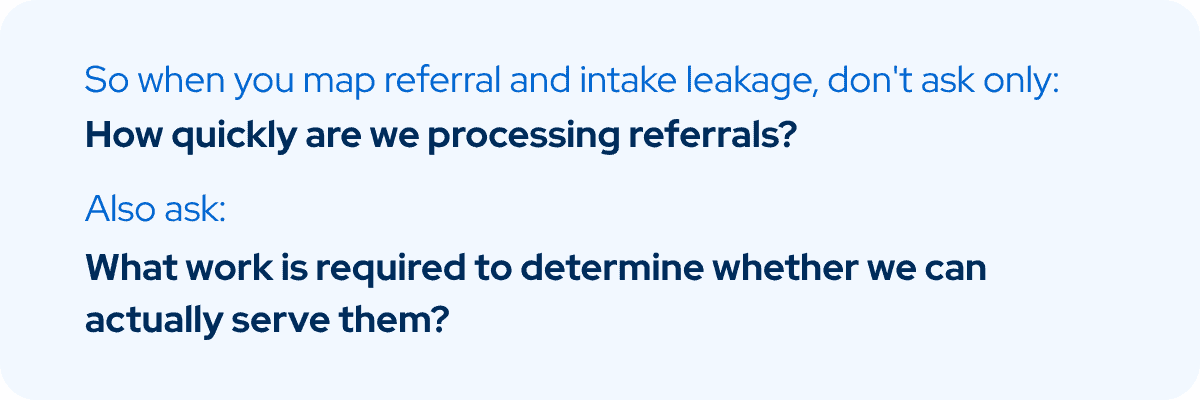
Intake Central is designed to centralize referral visibility, support configurable workflows, eligibility activities, task management and data management, and create a more connected handoff into downstream scheduling.
It’s important to address this challenge before growth adds more complexity. Processes that depend on a few experienced employees to keep referrals moving manually become harder to sustain as volume and payer requirements increase.
Home Health: Separate External Pressure from Internal Friction
For home health leaders, reimbursement pressure can make it tempting to view margin primarily through rates and payer mix. The operational picture is broader. PDGM economics, LUPA management, start-of-care timing, clinician utilization, Medicare Advantage authorization requirements, documentation supporting medical necessity and skilled care, and billing readiness all intersect with financial performance.
Use the Margin Leakage Map to separate what you can’t control from what you can improve.
You may not control a payer’s authorization requirements, but you can examine how quickly your organization identifies those requirements, how much manual effort is needed to manage them, and where authorization-related work creates delays.
Similarly, you may not control reimbursement rates, but you can investigate whether scheduling inefficiency, documentation rework, underused capacity, or preventable administrative work is adding cost to care delivery.
And if LUPA exposure is an issue, leaders need enough visibility into visits and workflows to identify emerging operational issues early and respond appropriately. Different sources of margin pressure require different responses. The first job is knowing which problem you’re actually trying to solve.
Hospice: Look for Variation as Well as Cost
Hospice organizations have their own points of operational pressure. Eligibility and certification requirements, documentation, staffing intensity, program integrity expectations, HOPE-related workflows, and consistency across branches or service areas can all add operational complexity.
Hospice leaders should also use the Margin Leakage Map to look for variation. Are branches handling the same process differently? Are teams relying on workarounds? Does the same documentation issue repeatedly return for correction? Are eligibility, certification or other required workflows creating repeated manual follow-up? Does growth in census create a corresponding increase in administrative work?
A purpose-built hospice EHR can help standardize workflows and give leaders greater visibility into how work is being performed across teams and locations. That creates an opportunity to address inconsistency inside the workflow instead of relying only on retrospective correction.
Your EHR Should Help You Find the Leak
The Margin Leakage Map is intentionally something you can use without buying anything. But it also creates a useful test for the technology you already have.
Test your visibility by considering how many of the following items you can see without conducting a manual investigation. Can leaders identify referral and non-admit patterns; see start-of-care performance; understand visit utilization and clinician productivity; identify incomplete documentation and clinical-review queues; and see scheduling utilization, billing readiness and financial trends?
HCHB provides purpose-built EHR solutions for both home health and hospice, helping each service line connect the clinical, operational, compliance, and financial workflows at the center of care delivery. Visibility is an aspect of an EHR that is becoming more valuable over time. Leaders who can see where friction is occurring, determine what’s causing it, and address the source rather than continually managing its downstream effects are better able to adapt and innovate.
Interim HealthCare Provides a Visibility Example
Interim uses HCHB Analytics to examine clinical and operational metrics, including productivity and back-office workflow. Rather than treating an individual metric as the answer, its approach is to understand the operational story behind the number, what is driving the result, and where the organization may need to look next.
A financial result tells you what happened. Operational visibility helps you investigate why. When clinical, operational, and financial workflows are connected, leaders have a stronger foundation for deciding what deserves attention first.
You Don’t Have to Be “Big Enough” to Fix Friction
Smaller and midsize agencies can face a particular trap: assuming modernization becomes necessary only after the organization reaches a certain size. But waiting can make today’s workarounds tomorrow’s operating model.
A manual process that works at today’s census may become increasingly difficult as volume grows, but the answer isn’t to automate everything because growth might happen. It’s to identify where the current operating model already creates friction and determine which changes would remove the most consequential constraints. That is a much more manageable place to start.
Your Next Step: Pick One Workflow
Don’t turn the Margin Leakage Map into a six-month transformation project. Choose one branch, service line, or workflow and complete the map with the people closest to the work.
Find the most frequent source of delay, rework, or capacity loss. Then keep tracing it backward until you understand its likely source. If scheduling is the issue, determine whether the constraint is staffing, visibility, or the amount of manual work required to build the schedule.
If documentation is creating rework, identify what repeatedly reaches clinical review incomplete and whether the workflow could address it earlier. If billing is delayed, determine which upstream requirement is holding the record back.
If intake is consuming more resources as referrals increase, examine how much of the process is manual and whether teams have the visibility needed to make serviceability decisions efficiently.
Then choose one thing worth changing.
You don’t need to wait until the organization is larger. You don’t need every process to be broken. And you don’t need to transform the entire operation at once. You need enough visibility to know where the friction is coming from and a better workflow for doing something about it.
See What Your Operations Could Be Telling You
If your Margin Leakage Map exposes friction across intake, scheduling, documentation, or other core workflows, HCHB can help you explore what’s creating the drag and where a more connected operating model could make a difference.