
Artificial intelligence is rapidly becoming part of everyday clinical workflows in home-based care. From ambient documentation tools to AI-assisted medication review and predictive clinical insights, organizations are investing in technology designed to reduce administrative burden and improve workflow efficiency. But technology alone does not guarantee success. Effective clinician AI training is one of the most important factors influencing adoption, documentation quality, clinician satisfaction, and long-term workflow improvement.
For home health and hospice organizations, AI training for clinicians should focus on helping teams understand how to work alongside AI responsibly while maintaining strong documentation integrity and clinical oversight. Here are six clinician AI training best practices organizations should prioritize when implementing AI-powered documentation workflows.
Why clinician AI training matters now
Home-based care organizations are facing increasing documentation complexity, staffing pressures, clinician burnout, and rising operational demands. AI is emerging as an important tool to help organizations support clinicians while improving workflow efficiency and documentation consistency.
However, AI adoption in healthcare requires more than implementation. Clinicians need practical education that helps them understand:
- How AI-assisted documentation works
- What makes documentation compliant and defensible
- How to validate AI-generated content
- How to integrate AI naturally into patient visits
- How to maintain clinical oversight and judgment
Organizations that invest in clinician documentation training before rollout are often better positioned for long-term adoption success. For a deeper look at how AI is reshaping clinical and operational workflows across home-based care, download the report: AI in Clinical & Revenue Operations: A Responsible, Embedded Intelligence Strategy for the Future of Home-Based Care.
1. Start clinician documentation training before AI rollout
One of the most important clinician AI training strategies is reinforcing documentation fundamentals before introducing AI-assisted workflows. AI can accelerate documentation processes, but it cannot replace clinical reasoning or correct incomplete narratives. Clinicians need to understand what makes a note clinically complete, compliant, and defensible before they begin reviewing AI-generated drafts.
Strong clinician documentation training should reinforce:
- Medical necessity
- Need for skilled care
- Clinical progression
- Risk identification
- Care plan alignment
- Regulatory documentation requirements
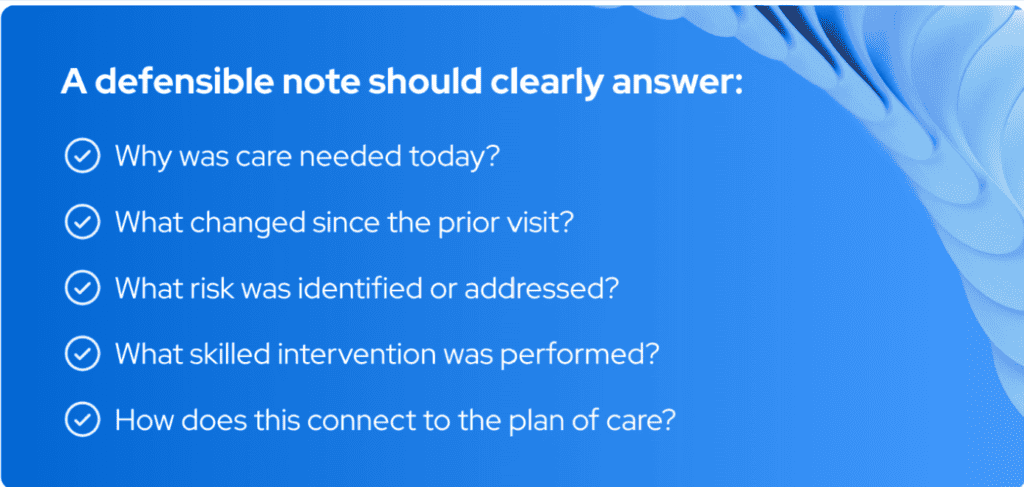
Organizations that strengthen documentation skills before AI implementation often see better adoption outcomes and stronger documentation quality over time.
2. Teach clinicians how to verbalize clinical reasoning
One of the most important AI documentation tips for nurses is learning how to verbalize clinical reasoning during patient visits. Ambient AI tools capture spoken interactions. If clinicians are silently assessing patient conditions or mentally evaluating risk without verbalizing observations, those insights may not appear in the AI-generated draft note. Clinician AI training should help staff become comfortable narrating care naturally during visits.
Examples include:
- “Based on today’s assessment findings…”
- “The patient continues to require skilled nursing because…”
- “Compared to the prior visit, I observed…”
- “Today’s intervention focused on reducing risk related to…”
This approach helps improve AI-generated documentation quality while reducing post-visit editing time. The goal is to help clinicians externalize their clinical reasoning so documentation more accurately reflects the care being delivered.
Additional resource for clinical trainers
Organizations preparing clinicians for ambient documentation workflows may also benefit from the guide: AI Training 101: What Clinicians Need to Know with Michelle Barlow. The resource includes defensible note guidance, clinician narration strategies, and practical training recommendations for AI adoption.
 AI Training 101: What Clinicians Need to Know with Michelle Barlow
3. Normalize the learning curve during AI adoption
AI adoption is a workflow transition, not simply software deployment. Many clinicians need time to adapt to ambient documentation workflows, AI-generated summaries, and new documentation review processes. Early implementation experiences in home-based care suggest clinicians often require several weeks to become fully comfortable with AI-assisted documentation workflows. Successful AI training for clinicians should establish realistic expectations early.
Organizations should communicate that:
- AI-generated notes still require clinician review
- Initial workflow adjustments are normal
- Efficiency gains improve with practice
- Confidence develops gradually over time
Responsible AI adoption should prioritize phased implementation, clinician feedback, and ongoing support rather than large-scale “big bang” deployments. This approach helps improve trust, reduce resistance, and support long-term adoption success.
4. Build training around real home health and hospice workflows
One of the best practices for AI documentation in home health and hospice is designing training around real-world care environments.
Home-based care introduces unique care complexity, including:
- Variable home environments
- Family participation during visits
- Background noise
- Connectivity interruptions
- Mobile documentation workflows
- OASIS or HOPE documentation requirements
- Complex medication reconciliation
Generic AI demonstrations rarely prepare clinicians for these realities. Organizations should train clinicians using situations that reflect actual patient care environments, not idealized examples.
Effective clinician AI training should include:
- Scenario-based learning
- Real visit simulations
- Ambient documentation practice
- Side-by-side note review exercises
- Documentation editing exercises
- Workflow coaching sessions
This helps clinicians understand how AI fits naturally into existing workflows while improving confidence during adoption.
5. Reinforce that AI supports clinicians, not replaces them
Successful clinician AI training programs consistently reinforce that AI is designed to support care delivery, not replace clinical judgment.
Responsible AI in healthcare requires:
- Human oversight
- Explainability
- Transparency
- Governance
- Clinician control
HCHB’s AI strategy emphasizes embedded intelligence, human-in-the-loop governance, bias monitoring, and clinician partnership as core principles of responsible AI adoption.
Training should reinforce that:
- Clinicians remain responsible for final documentation
- AI-generated content requires validation
- Clinical judgment always takes priority
This messaging helps build trust while reducing anxiety around AI adoption. The future of home-based care is not AI replacing clinicians. It is AI-enhanced workflows that help clinicians spend more time focused on patients and less time managing administrative tasks.
6. Treat clinician AI training as an ongoing process
AI healthcare regulations will continue evolving rapidly. Organizations should treat clinician AI training as an ongoing operational competency rather than a one-time implementation project.
Long-term success often depends on continuous education strategies, including:
- Refresher training sessions
- Peer coaching
- AI documentation review exercises
- Office hours and support channels
- Workflow optimization feedback loops
- Regulatory update education
- Ongoing adoption monitoring
Continuous education helps organizations strengthen adoption, identify workflow friction early, and improve clinician confidence over time. It also supports more responsible AI governance as organizations expand AI usage across clinical, operational, and revenue cycle workflows.
Why clinician AI training matters for home-based care
AI has the potential to help home health and hospice organizations reduce documentation burden, improve workflow consistency, support operational efficiency, and strengthen documentation quality.
But successful AI adoption depends on more than technology deployment.
Organizations that invest in clinician documentation training, workflow alignment, and responsible AI education are better positioned to improve adoption outcomes while preserving clinician trust and oversight.
The organizations that succeed with AI will likely be the ones that implement it responsibly, transparently, and in partnership with the clinicians delivering care every day.
To learn more about responsible AI strategies for home-based care organizations, explore these additional resources:
- AI in Clinical & Revenue Operations: A Responsible, Embedded Intelligence Strategy for the Future of Home-Based Care
- AI Training 101: What Clinicians Need to Know with Michelle Barlow
The organizations that succeed with AI will likely be the ones that implement it responsibly, transparently, and in partnership with the clinicians delivering care every day.
 AI in Clinical & Revenue Operations: