
A completed schedule tells you where clinicians are supposed to be. A capacity plan tells you whether the organization is making thoughtful use of the clinical resources it has. That requires looking beyond whether every visit has an assignment by asking:
- How is work distributed across the team?
- How much clinical time is being consumed by travel?
- How predictable are clinicians’ schedules?
- Are continuity and patient preferences being considered?
- Can leadership see enough of the upcoming schedule to understand what additional care the team can reasonably support?
When clinicians are already difficult to recruit and retain, those questions belong in workforce planning. Better scheduling won’t eliminate a genuine need for more clinicians, but it can help an agency make more informed decisions about how available clinical resources are deployed.
Use the schedule to answer more than “Who can take this visit?”
Scheduling in home-based care requires balancing constraints that don’t always align neatly. The clinician who is available may be far from the patient. A geographically efficient assignment may interrupt continuity. Optimizing only one variable can create problems elsewhere.
A useful schedule needs to balance workload, travel, predictability, continuity, and capacity visibility. Those five dimensions form the basis of a Scheduling Scorecard leaders can use to evaluate whether their scheduling process is doing more than filling open slots.
The 5-Part Scheduling Scorecard
Choose a representative team, branch, or service area and review several weeks of schedules. Don’t evaluate the scheduler. Evaluate the schedule the organization is producing.
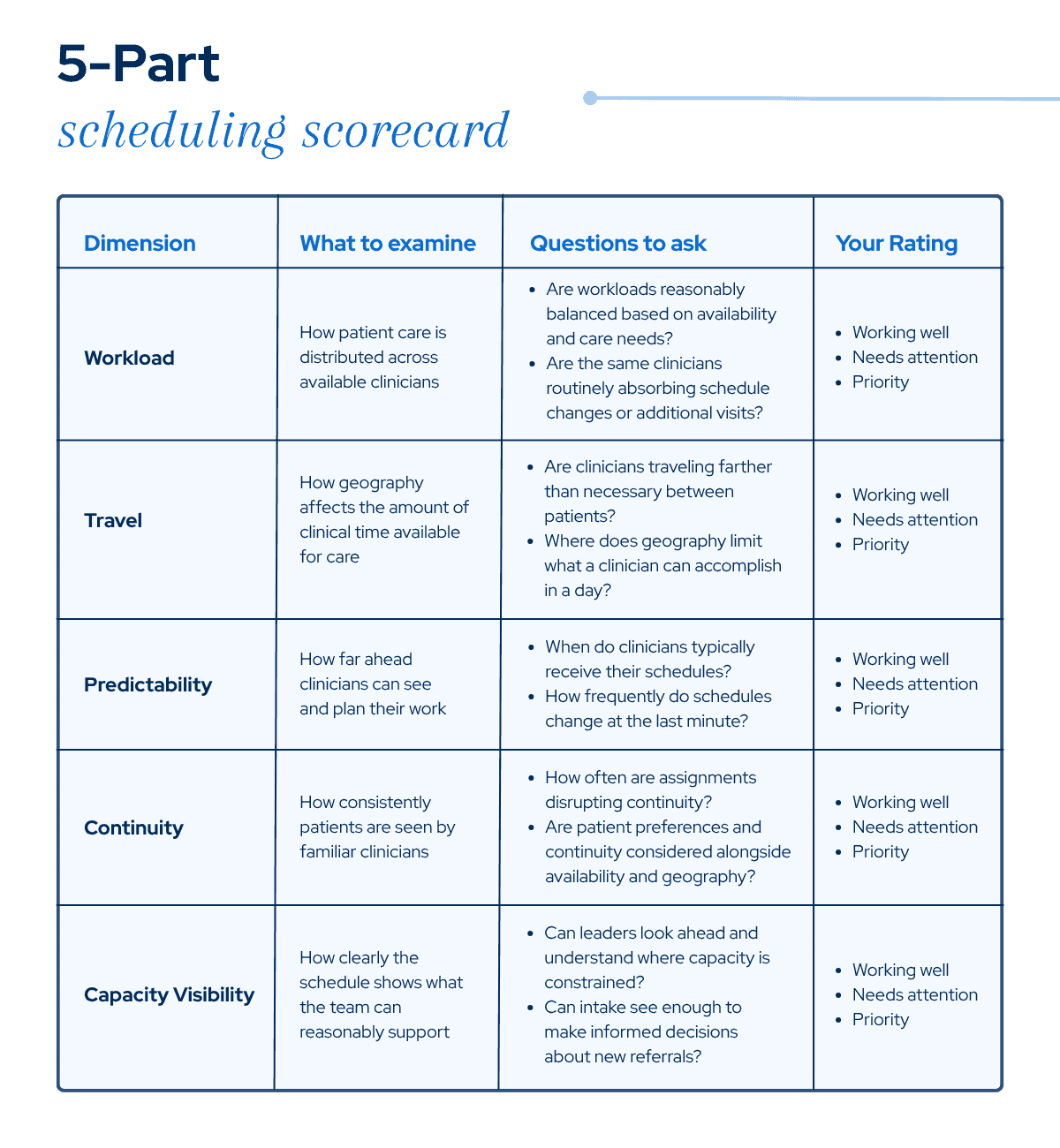
Rate each dimension as Working well, Needs attention, or Priority.
We recommend the following definitions for the ratings:
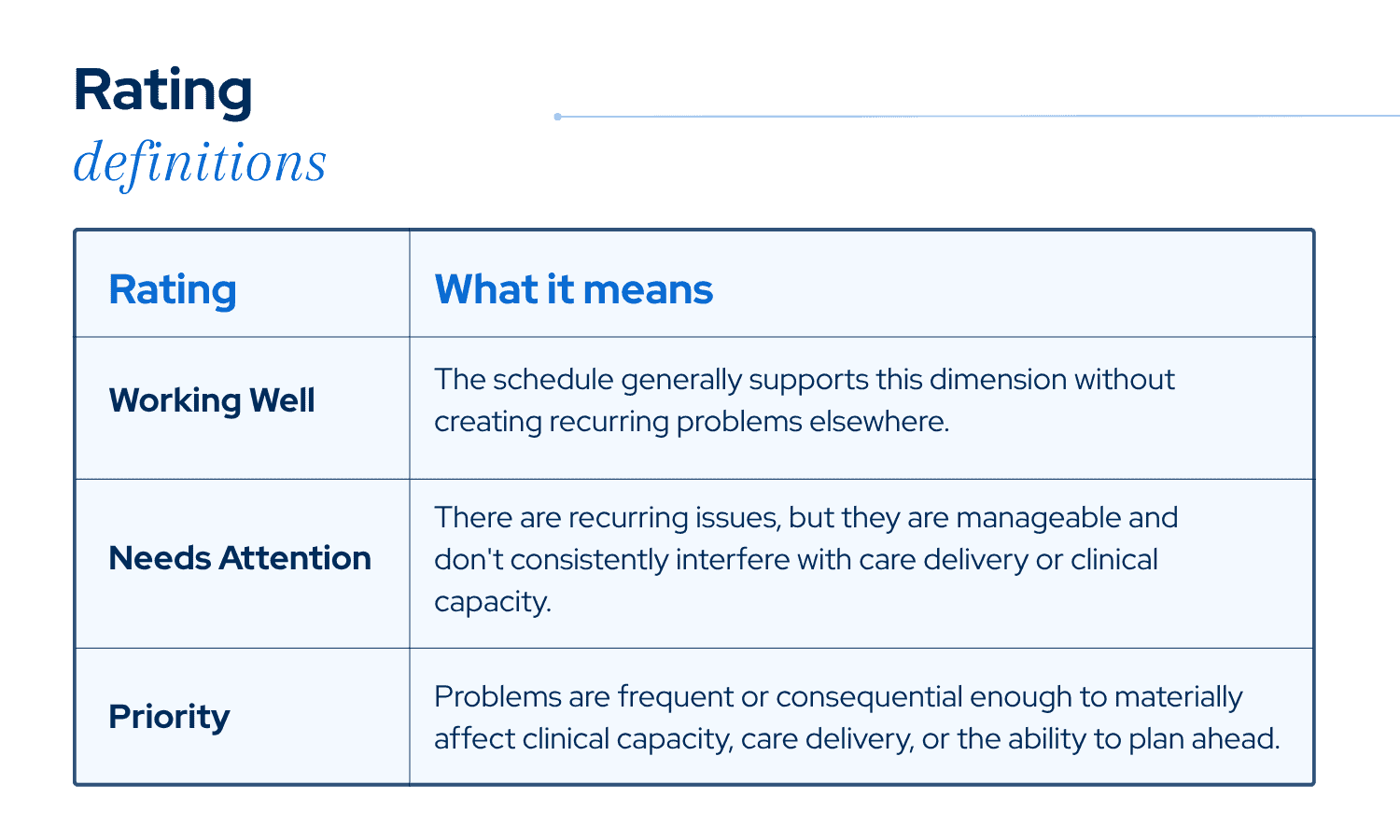
Don’t add the ratings together to create an overall scheduling score. The value comes from identifying where the schedule is creating the greatest operational constraint and understanding how improvement in one area may affect the others. For example, a schedule with minimal travel isn’t necessarily a good schedule if it creates major workload imbalances or repeatedly breaks continuity. A highly predictable schedule isn’t useful if it can’t accommodate changing patient needs, and a schedule that appears full may not tell leadership whether the team has the right capacity for the next patient who needs care. Use the scorecard to see what the schedule is optimizing today and what may be getting sacrificed in the process.
1. Workload: Look beyond the number of visits
Visit counts can be useful, but equal numbers don’t necessarily mean equivalent workloads. Patient needs differ. Clinician availability differs. Geography differs. Some schedules are more susceptible to changes than others. A useful capacity plan needs enough information to distribute work in a way that reflects those realities.
Look for patterns over several weeks rather than judging a single difficult day.
Ask:
- Are particular clinicians consistently carrying heavier schedules?
- Are others routinely absorbing last-minute visits?
- Does the team have a clear view of who is available before assignments are made?
- When schedules change, is workload being rebalanced or simply added to whoever can accommodate the request?
This isn’t about maximizing the number of visits each clinician can complete. It’s about using available clinical resources thoughtfully enough to support sustainable care delivery.
2. Travel: Account for the geography of care
Travel is part of home-based care, not an inefficiency that can simply be eliminated, but geography directly affects how clinical capacity can be deployed. A clinician who spends more time traveling between patients has less time available for other work, regardless of what the visit count alone suggests.
That makes routing and geography part of capacity planning. The impact can be particularly significant in rural service areas. Visiting Nurse Association of Southeast Missouri, for example, reported that some clinicians drive as much as an hour between visits. In that environment, a missed visit could result in substantial clinician time being lost to travel. Your own geography may look very different. The question is whether the schedule accounts for it.
Review where clinicians begin and end their days, the distance between assignments, and how often last-minute changes introduce additional travel. The objective isn’t the shortest possible route at the expense of everything else. It’s to avoid treating travel as invisible time when determining what the team can reasonably support.
3. Predictability: Give clinicians a plan they can actually work from
A schedule is also a communication tool for the clinician. When assignments aren’t available until the last minute, clinicians have less ability to anticipate their workload, plan travel, or prepare for the week ahead. Frequent changes can make an already demanding field role more difficult to manage.
VNA of Southeast Missouri saw a significant change in this area after implementing HCHB Smart Scheduling. The organization reported that administrators had previously worked Sunday nights preparing Monday schedules, with clinicians sometimes receiving their schedules at the last minute. With Smart Scheduling, the team said it could plan Monday schedules by Friday afternoon, and clinicians could look further ahead at their upcoming work.
That example also illustrates an important point about scheduling efficiency. Reducing the amount of administrative effort required to build and maintain a schedule does not, by itself, increase clinical capacity. It can still reduce administrative cost and burden, however. And when a clinical resource is being used to perform that administrative work, the capacity implications can become direct.
At VNA of Southeast Missouri, an LPN had been handling scheduling full-time. After implementing Smart Scheduling, the agency reported that she spent about two hours a day on scheduling and was redeployed to patient visits for the remainder of her time.
4. Continuity: Don’t optimize it out of the schedule
The shortest route or easiest available assignment isn’t automatically the best assignment. Continuity deserves to be part of the scheduling decision because there is evidence linking consistent care relationships with important patient outcomes and experiences.
A study of 59,854 home health patients found greater consistency in nursing personnel was associated with a lower probability of hospitalization and emergent care and a greater likelihood of improvement in activities of daily living. A broader systematic review of continuity research found that eight of nine high-quality studies examining utilization identified an association between increased continuity and decreased healthcare utilization, including hospitalization and emergency visits, while five of seven found improved patient satisfaction with greater continuity.
The evidence provides a strong reason not to treat continuity as expendable when optimizing a schedule. Patient preferences belong in that conversation as well. A mathematically efficient assignment may be less desirable if it unnecessarily introduces another clinician into the patient’s home or disrupts an established care relationship.
For the Scheduling Scorecard, look at how frequently patients are being assigned to different clinicians and why. Some changes will be clinically appropriate or unavoidable. The useful question is whether continuity is visible enough to be considered when assignments are made.
5. Capacity visibility: Know what the schedule can support next
The schedule shouldn’t only organize the care you’ve already accepted. It can also help leadership understand what the organization may be able to support next. This is where scheduling becomes particularly valuable as a capacity-planning tool.
Consider a new referral. Knowing that a clinician has an opening isn’t enough. Administration needs to understand the patient’s expected care needs, clinician availability, geography, workload, and the ability to support the required visit pattern. Without forward visibility, answering those questions can require calls, messages, spreadsheets, or reliance on the scheduler’s knowledge of the team.
VNA of Southeast Missouri reported that improved visibility into staff availability helped the organization feel more comfortable evaluating additional referrals. Leadership could look ahead at the schedule and consider both whether capacity was available and the level of care a prospective patient would require.
Capacity visibility helps turn the schedule into a growth-planning tool. By looking beyond open slots to clinician availability, geography, workload, and patient needs, leaders can make more informed decisions about which additional referrals the organization is equipped to support.
Scheduling improvements should show up beyond the scheduler’s day
VNA of Southeast Missouri provides a useful example of what can happen when scheduling is treated as part of capacity planning rather than simply an administrative task. The organization had previously scaled back amid staffing challenges and reported turning down more referrals. After implementing HCHB Smart Scheduling, it was able to redeploy an LPN who had been scheduling full-time back into patient care for much of her day, plan schedules further in advance, and gain better visibility into staff availability when considering new referrals. The organization reported that its monthly average daily census increased by approximately 15%, returning to more than 200 patients.
The value wasn’t limited to making scheduling faster. A clinical resource was able to spend more time delivering patient care. Clinicians had greater visibility into upcoming schedules. Leadership had better information about available resources when evaluating whether the agency could support additional patients.
Other agencies may have different scheduling challenges, but the same idea applies. Look at what the schedule enables across the organization:
- Does it help the team make thoughtful use of clinician availability, geography, travel, workload, continuity, and patient preferences?
- Can leaders see far enough ahead to understand where resources are constrained and where additional care may be supportable?
Smart Scheduling is designed to help teams account for those considerations while reducing the manual effort required to build and adjust schedules. It doesn’t remove the need for individual judgment. Patient needs change, clinicians call out, urgent visits arise, and established care relationships may influence an assignment. Better scheduling technology can handle more of the routine tasks while giving people the information they need to focus on the decisions that require their judgment. The Scheduling Scorecard below provides a way to evaluate how well your current scheduling approach is accomplishing those goals.
Put the Scheduling Scorecard to work
Choose one team or branch and review several weeks of recent schedules. You want enough history to identify recurring patterns rather than isolated exceptions. Then rate the schedule across all five dimensions.
- Workload: Is care distributed reasonably across available clinicians?
- Travel: How much is geography shaping what clinicians can accomplish?
- Predictability: How far ahead can clinicians reliably see their schedules?
- Continuity: Are familiar clinicians and patient preferences being considered when assignments are made?
- Capacity visibility: Can leadership use the schedule to understand what additional care the team may reasonably be able to support?
Choose where to act first
A Priority rating identifies an area worth examining, but it doesn’t automatically make it the first problem to solve. If more than one dimension receives a “Priority” or “Needs attention” rating, use three factors to decide where to focus:
- Clinical capacity impact: How significantly is the issue limiting the effective use of available clinical resources?
- Care impact: Is it affecting continuity, patient preferences, timely care, or clinicians’ ability to manage their work?
- Frequency: Is this an occasional exception, or does the same problem appear repeatedly across schedules?
Start with an issue that is recurring and has a meaningful effect on clinical capacity or care. That gives the team a focused problem to work on rather than trying to optimize all five dimensions at once.
Before making a change, consider how that decision could affect the rest of the schedule. Reducing travel by routinely assigning the closest available clinician, for example, could improve geographic efficiency while weakening continuity. Building schedules further in advance can improve predictability, but the process still needs enough flexibility to respond when patient needs change. The goal is to improve one area without unnecessarily creating a problem in another.
Match the problem to a potential action
Once you’ve selected a priority, identify what is contributing to it before deciding how to respond. The appropriate solution will depend on the agency, but the following prompts can help narrow the options.
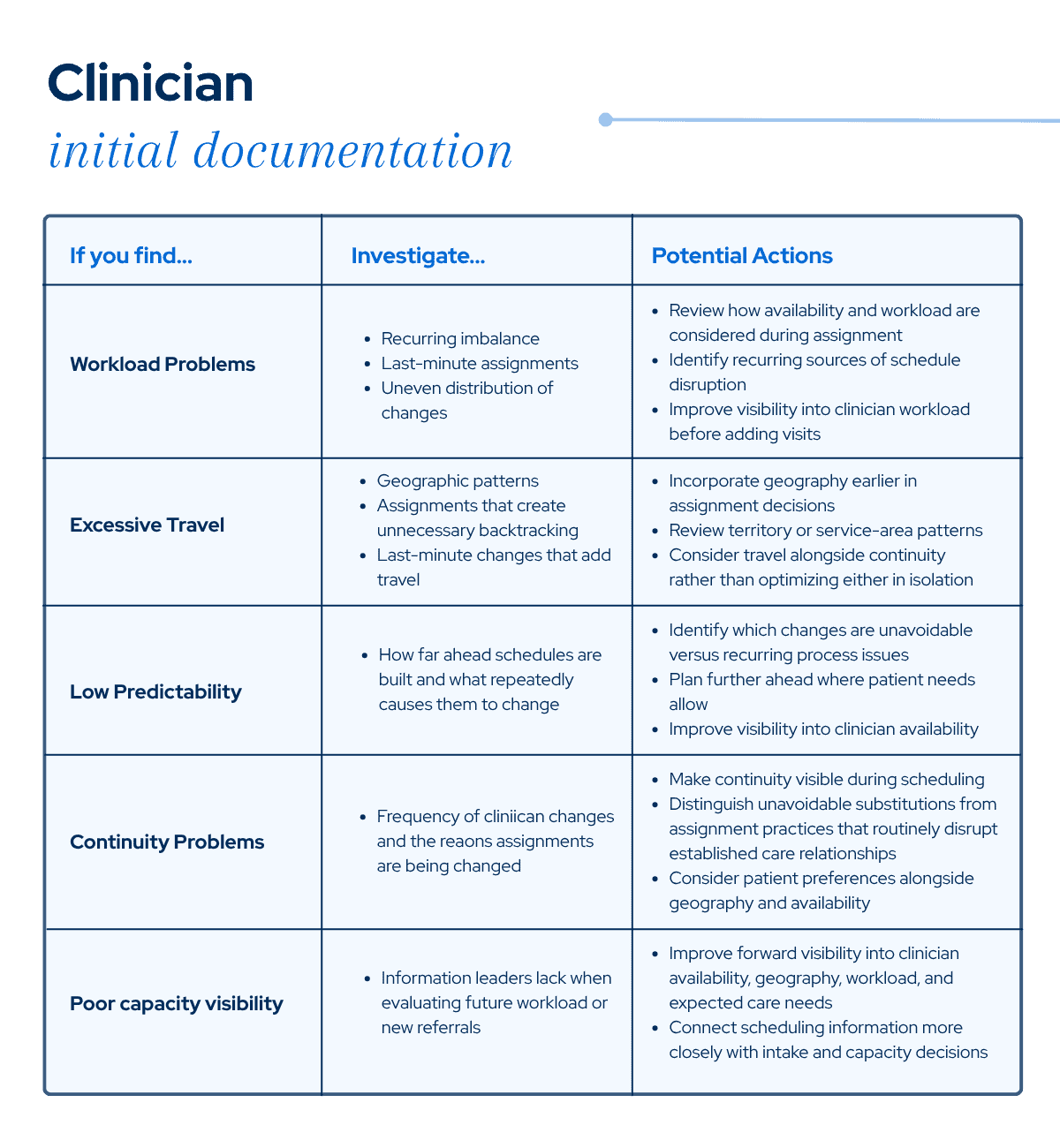
These aren’t prescriptions or universal benchmarks. Geography, staffing models, patient populations, and care needs all influence what a workable schedule looks like. The objective is to use the scorecard to identify a specific problem, understand what’s contributing to it, and choose an improvement that fits the organization.
Test the change against the whole schedule
Establish what the selected dimension looks like today, make one focused change, and reassess it after several scheduling cycles.
Then go back to the full scorecard:
- If travel improved, what happened to continuity and workload?
- If schedules became more predictable, did the team retain enough flexibility to respond to changing patient needs?
- If workload became more balanced, did travel increase significantly?
- If capacity became easier to see, did leadership have better information when evaluating new referrals?
An improvement in one dimension shouldn’t simply move the burden somewhere else. The strongest scheduling changes improve the deployment of clinical resources while maintaining an appropriate balance across the other dimensions.
Over time, the scorecard can become a recurring management exercise rather than a one-time assessment: identify the greatest constraint, make a focused change, evaluate the result, and move to the next priority.
Where Smart Scheduling fits
Some of the issues uncovered by the scorecard may be process issues. Others may reflect how much information schedulers can see and how much manual work is required to account for competing scheduling considerations.
HCHB Smart Scheduling helps teams consider factors such as clinician availability, workload, geography and travel, patient preferences, and continuity as they build and adjust schedules. It also provides greater forward visibility into the schedule, helping leaders better understand how available clinical resources are being deployed.
Technology doesn’t remove the judgment required to manage patient needs, staffing constraints, callouts, urgent visits, or other changes. It can make the information needed for those decisions easier to use and reduce the manual effort required to build and continually adjust a workable schedule.
Turn your schedule into a better capacity plan
Run the Scheduling Scorecard on one team or branch. If it reveals a recurring challenge with workload, travel, predictability, continuity, or capacity visibility, see how HCHB Smart Scheduling can help your team put those considerations into practice.