
Artificial intelligence is rapidly becoming part of everyday workflows in home health, hospice, palliative care, and personal care. From ambient listening tools to AI-assisted summaries and workflow automation, healthcare organizations are exploring new ways to reduce documentation burden and improve operational efficiency.
But as adoption increases, so does the need for strong ambient AI documentation review processes. AI can help generate faster documentation drafts. It can support workflow consistency. It can help surface insights earlier in the care journey. However, AI cannot replace clinical judgment, documentation accountability, or defensible decision-making.
That’s why learning how to review AI-generated content has become one of the most important emerging skills for clinicians, QA teams, and healthcare leaders. The organizations seeing the greatest success with healthcare AI are not removing humans from the process. They are implementing AI with governance, clinician oversight, and structured review workflows that help ensure documentation remains accurate, complete, and compliant.
Why ambient AI documentation review matters
Ambient AI tools are designed to capture conversations, summarize interactions, and generate medical notes that support documentation workflows. In home-based care, these tools can help reduce administrative burden and improve efficiency during patient visits.
Healthcare organizations are increasingly using AI to support:
- Ambient documentation
- Medication extraction and reconciliation
- Clinical summaries
- Predictive hospitalization risk workflows
- Administrative automation
- Workflow assistance and task routing
These capabilities create meaningful operational opportunities, especially in environments facing staffing shortages, increasing documentation requirements, and rising patient complexity. But efficiency gains only matter if documentation quality remains intact.
One of the biggest misconceptions about AI-generated medical notes is that polished language automatically equals compliant documentation. In reality, an AI-generated note can sound complete while still missing clinical reasoning, skilled rationale, progression details, or risk context. That gap creates both compliance and patient safety concerns.
The hidden risks inside AI-generated medical notes
AI-generated content in healthcare introduces both opportunity and risk. Strong ambient AI documentation review processes help organizations identify those risks before inaccurate or incomplete documentation becomes part of the medical record.
Several risks are becoming increasingly common across healthcare AI workflows.
Omission bias in AI-generated content
Omission bias occurs when important information is missing because it was never verbalized, prompted, or captured during the patient encounter. Ambient AI tools are highly effective at capturing what is said aloud. They are less effective at capturing silent assessments, internal clinical interpretation, or unspoken observations.
This can result in:
- Missing skilled rationale
- Incomplete progression documentation
- Absent safety concerns
- Limited comparison to prior visits
- Weak clinical context supporting medical necessity
In home health and hospice documentation, what is missing from the note is often what creates the greatest regulatory risk.
Hallucinations in AI-generated medical notes
Hallucinations occur when AI generates details that sound plausible but were never discussed, observed, or documented during the visit.
Examples may include incorrect medication details, symptoms the patient never reported, or unsupported clinical conclusions. Even minor inaccuracies can create downstream compliance concerns and patient safety risks if they become part of the permanent medical record.
A study published on PubMed Central on Artificial intelligence hallucinations in anesthesia addresses the causes of AI hallucinations and the potential threats for healthcare. While the anesthesia use case is not directly applicable to home-based care, the study clearly illustrates how hallucinations can lead to serious errors in medication, communication and documentation.
Automation bias in healthcare
One of the fastest-growing risks associated with AI-generated medical notes is an over-reliance on automated output. Automation bias happens when clinicians or reviewers over-trust AI-generated output because it appears polished, organized, or professionally written. This type of automation bias in healthcare can lead clinicians to accept incomplete or inaccurate notes without sufficient review.
Symptoms of automation bias include:
- Minimal editing of AI drafts
- Incomplete review workflows
- Missing clinical context
- Notes that “sound right”, but lack accuracy
Remember, polished writing is not the same thing as defensible documentation. In healthcare, clinicians remain accountable for the final record. That responsibility does not disappear simply because AI assisted with documentation generation.
How to review AI-generated content effectively
Organizations implementing ambient AI documentation tools need clear review standards that help clinicians validate both accuracy and clinical meaning. An effective ambient AI documentation review process should focus on whether the note clearly tells the story of the visit and demonstrates skilled care. One practical framework is evaluating whether the documentation answers five critical questions.
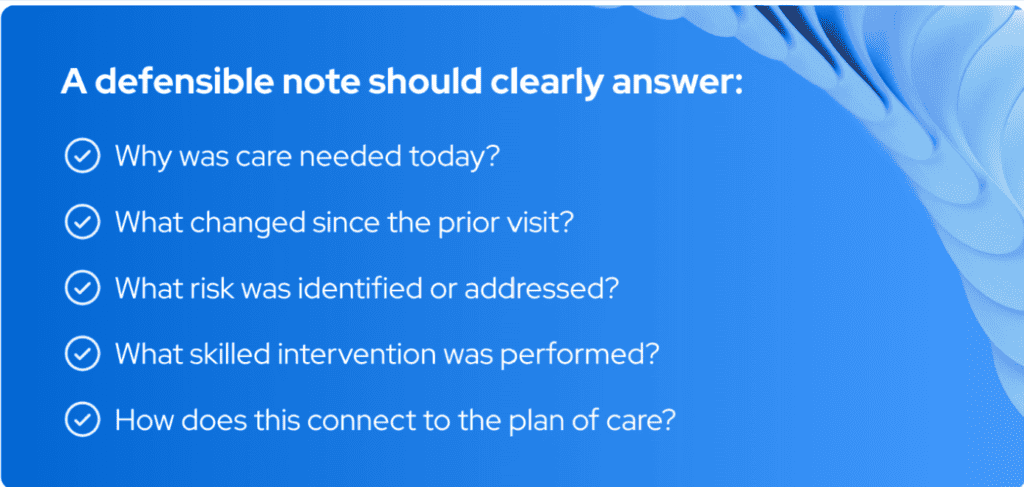
If those answers are unclear, the note likely requires additional clinical context or clarification. This approach shifts the review process beyond grammar and readability and toward clinical defensibility.
As organizations implement AI-assisted workflows, successful adoption depends on more than technology alone. Clinicians need practical guidance on how to evaluate AI-generated medical notes, identify missing clinical reasoning, and ensure documentation remains accurate and defensible.
Read AI Training 101: What Clinicians Need to Know to learn practical strategies for reviewing AI-generated content, strengthening defensible documentation, and helping care teams adapt to ambient AI workflows with confidence.
 AI Training 101: What Clinicians Need to Know
Why human review remains essential
AI can support documentation workflows, but it cannot independently validate clinical judgment, medical necessity, or patient-specific nuance.
That’s why many healthcare organizations are adopting human-in-the-loop governance models for AI workflows. In these models, AI assists with draft generation while licensed clinicians remain responsible for reviewing, editing, validating, and finalizing documentation before it becomes part of the patient record.
This governance model supports:
- Documentation accuracy
- Regulatory defensibility
- Clinical accountability
- Transparency in AI workflows
- Reduced automation bias in healthcare
It also reinforces an important reality: AI-generated medical notes should support clinicians, not replace them.
Ambient AI documentation review is becoming a core healthcare competency
As AI adoption expands across home-based care, ambient AI documentation review is quickly becoming a foundational operational and clinical competency.
The organizations best positioned for long-term success will likely be the ones that invest early in:
- AI governance standards
- Clinician education
- Documentation defensibility training
- Human oversight workflows
- Responsible AI implementation strategies
AI can help healthcare organizations reduce administrative friction and support more efficient workflows. But strong outcomes still depend on human expertise, clinical reasoning, and thoughtful review processes.
The future of healthcare AI is not about removing clinicians from the equation. It is about creating workflows where technology and clinical judgment work together to improve care quality, operational performance, and documentation integrity.
Reviewing AI-generated content is only one part of responsible AI adoption in home-based care. As organizations expand AI across clinical, operational, and revenue workflows, leaders also need governance strategies that support transparency, clinician trust, and long-term scalability.
Explore the future of responsible AI in home-based care
Read our latest report on AI in clinical and revenue operations to learn how healthcare organizations are approaching embedded intelligence, human-in-the-loop governance, predictive workflows, and operational AI strategy across home health and hospice.
Because in home-based care, trust is built on documentation that is not only efficient, but accurate, defensible, and clinically meaningful.
 latest report on AI