
For years, home-based care organizations competed by expanding referral networks, improving reimbursement performance, and growing census. Today, demand is no longer the industry’s greatest constraint. Capacity is.
The increased demand across home health, hospice, and personal care is driven by an aging population, continued migration of care into the home, and patient preference for home-based services. Yet many providers struggle to capitalize on that opportunity because they don’t have the workforce capacity to serve every referral.
According to HCHB analytics, 63.3% of providers reported turning down referrals. Additionally, non-admits for workforce-related reasons remain approximately twice pre-pandemic levels.
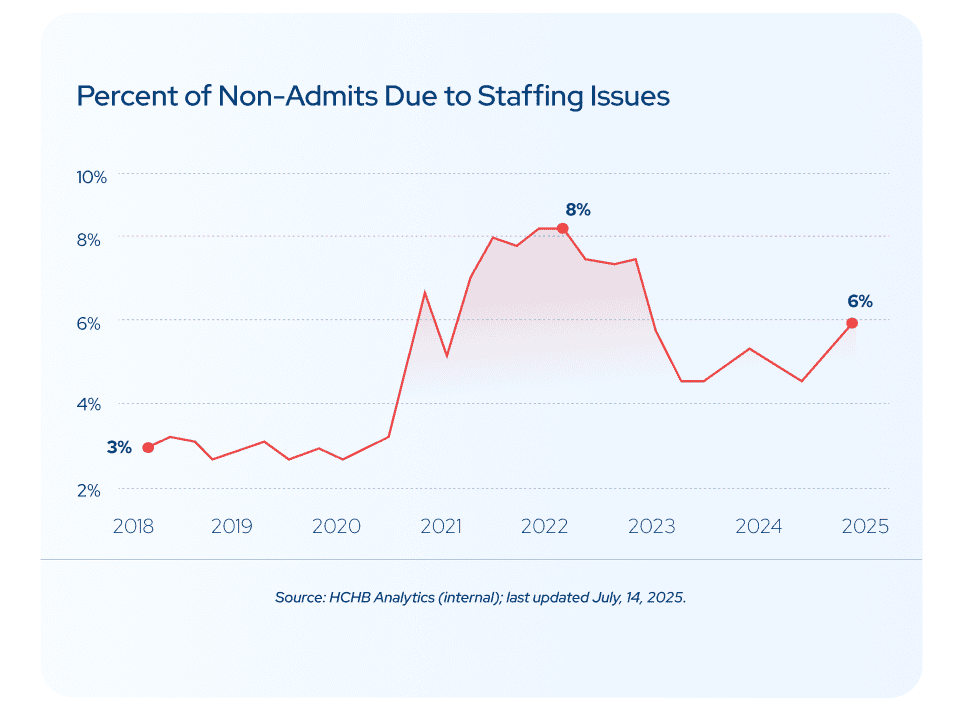
This represents more than a workforce challenge. It represents a shift in the economics of growth. For many organizations, the competitive advantage is no longer determined by who generates the most referrals. It’s determined by who can reliably convert demand into patient care and that requires a different approach to workforce strategy. Leaders should consider workforce capacity a strategic asset that can either expand or constrain every other business objective.
Workforce capacity is an operational asset
Most workforce discussions begin with hiring questions. How many clinicians do we need? How quickly can we recruit them?
Those questions matter, but they overlook something more fundamental. Every clinician has a finite amount of productive capacity each day. The way an organization designs work determines how much of that capacity is ultimately available for patient care.
Administrative burden, fragmented workflows, inefficient scheduling, duplicate documentation, and communication gaps all consume clinician time without creating additional clinical value. Viewed collectively, they represent lost organizational capacity. Organizations that improve workforce capacity create growth internally by enabling existing clinicians to spend more of their time delivering care rather than navigating unnecessary operational complexity.
In many industries, executives focus on maximizing the return on financial assets. The same mindset increasingly applies to workforce capacity. The objective isn’t simply employing more clinicians. It’s maximizing the capacity of every clinician already on the team.
Operational design determines organizational performance
Organizations often evaluate workforce health using lagging indicators such as turnover, vacancy rates, and time-to-fill positions. Those metrics describe the outcome, but they rarely explain the cause.
The operational realities clinicians experience every day are often far more predictive of long-term workforce performance than hiring statistics alone. Turnover often follows months of accumulated operational friction:
- Unpredictable schedules
- After-hours documentation
- Poor workload visibility
- Disconnected communication
- Manual administrative processes
The workforce research in What Clinicians Are Really Asking for and What It Means for Your Retention Strategy reinforces this pattern. Clinicians consistently identify more predictable schedules, fewer administrative obstacles, stronger communication, and more time with patients as priorities for improving their work experience.
These aren’t simply employee preferences. They’re indicators of organizational design. When operational systems create unnecessary complexity, workforce capacity begins declining long before turnover appears on an executive dashboard. By the time experienced clinicians leave, organizations have often already absorbed months of lost productivity, increased management effort, reduced scheduling flexibility, and declining referral acceptance. Turnover is not usually the beginning of the problem. It’s the result of capacity that has been quietly eroding over time.
Capacity creates strategic flexibility
Organizations with stronger workforce capacity don’t simply serve more patients:
- They respond more effectively to change.
- They can accept referrals with greater confidence.
- They adapt more quickly to fluctuations in census.
- They onboard new clinicians without overwhelming experienced staff
- They expand into new markets without creating unsustainable workloads
In other words, workforce capacity creates organizational resilience which is a key competitive differentiator in markets under pressure. Healthcare leaders cannot predict every reimbursement change, workforce disruption, or market shift. They can, however, build organizations capable of adapting to those changes more effectively. That adaptability begins with operational capacity.
Leading organizations manage capacity, not just staffing
Historically, workforce management focused on headcount. Today’s highest-performing organizations increasingly focus on capacity management. That means asking different questions.
- Instead of measuring only vacancy rates, leaders examine workload distribution.
- Instead of reacting to burnout, they identify operational bottlenecks earlier.
- Instead of evaluating productivity in isolation, they examine how documentation, scheduling, communication, and coordination influence clinicians’ ability to deliver care.
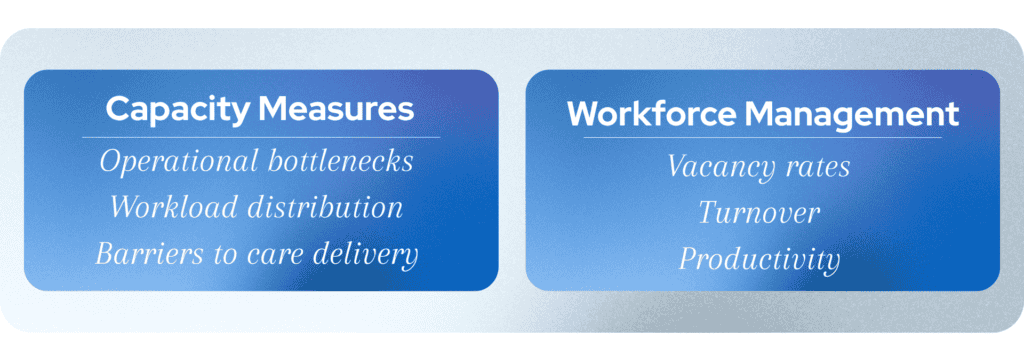
This represents a broader evolution in operational leadership. Capacity becomes something organizations intentionally design, continuously monitor, and strategically improve. Technology plays an important role in enabling that visibility, but technology alone isn’t the strategy. The real advantage comes from using operational insight to make better leadership decisions before workforce challenges become organizational constraints.
The next competitive advantage won’t be more demand
Demand for home-based care is expected to continue growing for years to come. The organizations that lead the next decade won’t necessarily be those with the largest workforce or the strongest referral networks. They’ll be the organizations that consistently create more capacity from the workforce they already have. Building workforce capacity starts with understanding the operational realities shaping the clinician experience.
Download What Clinicians Are Really Asking For and What It Means for Your Retention Strategy to explore the research behind today’s workforce challenges and discover practical strategies for reducing operational friction, strengthening clinician retention, and building the capacity needed for long-term growth.
 What Clinicians Are Really Asking for and What It Means for Your Retention Strategy