For home health and hospice leaders, an external review can come in several forms. A State Survey Agency may evaluate compliance with Medicare Conditions of Participation (CoPs). An accrediting organization may conduct a survey for accreditation and Medicare deemed status. A Medicare Administrative Contractor (MAC) may request documentation to determine whether a claim meets Medicare coverage and payment requirements.
These reviews aren’t interchangeable. But they often have something important in common: The reviewer needs evidence that the organization is operating as required and that the patient record supports what happened.
For compliance and clinical leaders, survey and audit readiness means understanding who may review the organization, what each reviewer is responsible for, and what the agency’s records and operations look like from the outside.
Who surveys home health and hospice agencies?
Home health and hospice providers operate within an oversight ecosystem rather than answering to a single surveyor, auditor, or regulator. Understanding the differences starts with knowing who is looking and why.
CMS and State Survey Agencies
The Centers for Medicare & Medicaid Services (CMS) establishes the federal requirements that home health agencies and hospices must meet to participate in Medicare, including the applicable CoPs. State Survey Agencies (SAs) conduct certification and recertification surveys and investigate complaints on CMS’s behalf, among other responsibilities.
During a Medicare certification survey, the central question is whether the provider complies with applicable federal requirements. Surveyors use CMS survey protocols and interpretive guidance to evaluate the organization’s performance and practices. Depending on the findings, a survey can result in deficiencies, plans of correction, revisits, or other enforcement actions.
Accrediting organizations
CMS-approved accrediting organizations (AOs) provide another pathway. Organizations may voluntarily use accreditation through a CMS-approved program to demonstrate compliance with Medicare health and safety requirements. This is commonly called deemed status.
That means accreditation and a Medicare survey aren’t necessarily two entirely separate processes. When an approved AO conducts a deemed survey, its standards must meet or exceed Medicare requirements, and its survey processes must be comparable to those used by State Survey Agencies. An accrediting organization may also establish requirements beyond the Medicare baseline. This distinction is particularly important because the terms accreditation and survey are sometimes used as though they mean the same thing. They don’t.
Accreditation vs. surveys: What’s the difference?
Think of accreditation as a status or program and the survey as a process used to evaluate compliance. An organization can be surveyed by a State Survey Agency for Medicare certification. Or it may elect accreditation through a CMS-approved accrediting organization whose survey can establish deemed compliance with Medicare requirements. Accrediting organizations can also perform accreditation activities outside CMS’s deeming authority.
For providers, the overlap is significant. Whether a surveyor represents the state or a CMS-approved accrediting organization, the agency needs to demonstrate that applicable requirements are reflected in actual practice, not just policy.
CMS is also strengthening its oversight of accrediting organizations. Changes finalized in 2026 address areas including survey processes, validation, conflicts of interest, and the relationship between accreditation and consulting activities, with major provisions taking effect in June 2027.
For compliance leaders, the larger lesson is straightforward: readiness shouldn’t depend on which survey organization walks through the door.
What does an accrediting organization expect?
Teresa Harbour, RN, MBA, MHA, AFC-CP, Chief Operating Officer at Community Health Accreditation Partner (CHAP), describes accreditation as an ongoing approach to quality and compliance.

Why is accreditation helpful for agencies?
“CHAP accreditation helps organizations with ongoing quality and compliance. CHAP accreditation lays the foundation for consistency and long-term sustainability, not just checking a box. Our accreditation process provides timely surveys and supports organizations throughout their three-year accreditation cycle. State agencies and other accrediting organizations do not offer a customer service function as robust as CHAP. We assign organizations a Director of Accreditation (a clinician) along with an Accreditation Specialist to better support our customers and provide responsive answers to questions.”
What are important elements that providers should have ready when pursuing accreditation?
“The main elements are state licensure (if required), 855 application approval (if applicable), adherence to state/federal regulations (as applicable), and a staff person to lead the initiative. CHAP provides a series of calls to assist organizations with accreditation. These calls include a next step call (Accreditation Specialist provides information about their accreditation team, resources for readiness, and LINQ) and a readiness call (the final check in before transitioned to scheduling).”
What are your predictions for hospice oversight?
“It is likely that oversight for these provider types (hospice and home health) will remain, if not increase, due to reports of fraud and abuse in this space.”
Audits and medical reviews ask a different question
Not every external reviewer is evaluating organization-wide compliance with the CoPs. MACs perform Medicare administrative functions that include claims processing and medical review. Providers may encounter additional documentation requests and targeted medical review processes through their MAC. In those situations, the question is generally narrower: Does the documentation support Medicare coverage and payment for the claims being reviewed?
For home health: that can put particular importance on documentation supporting eligibility, homebound status, skilled need, the plan of care, services delivered, and other applicable coverage requirements.
For hospice: the clinical record needs to support terminal illness eligibility and the basis for the prognosis, along with applicable certification, recertification, face-to-face, and coverage requirements.
A completed form by itself may not tell the entire story.
What do surveyors and auditors actually see?
One of the most useful ways for compliance leaders to prepare for outside scrutiny is to stop looking at the record through the agency’s organizational structure. Reviewers don’t necessarily experience referral management, clinical operations, quality, compliance, and revenue cycle as separate departments.
They see the patient record. That record becomes the evidence trail connecting the agency’s decisions, care delivery, and, when applicable, reimbursement.
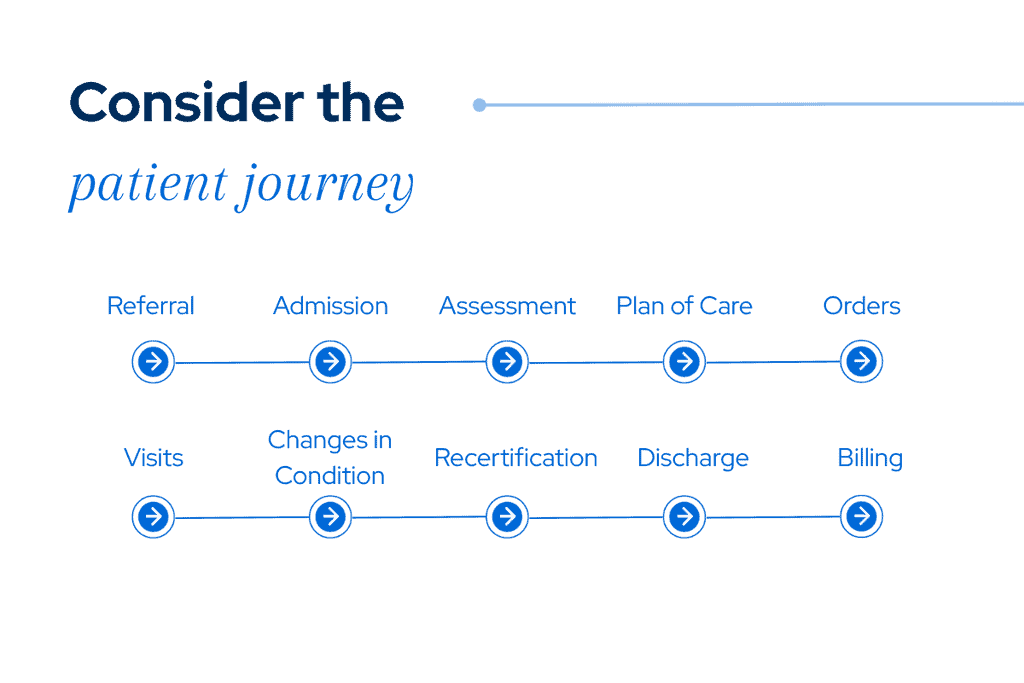
Consider the patient journey:
Referral → Admission → Assessment → Plan of care → Orders → Visits → Changes in condition → Recertification → Discharge → Billing
A problem at one stage can affect everything downstream. Incomplete referral information may affect an admission decision. An assessment that doesn’t fully capture the patient’s needs may create inconsistencies with the plan of care. An unresolved order may raise questions about services delivered. Documentation that fails to reflect a change in condition may weaken the clinical story supporting continued care.
Eventually, an operational or documentation problem can become a compliance or payment problem.
Surveyors look for a coherent clinical story
Having every required document doesn’t necessarily mean the record is strong. The documents also need to make sense together. For example, consider a home health record where the comprehensive assessment identifies one set of needs, the plan of care establishes another, and the visit documentation suggests something different happened in the home. Or consider a hospice record containing the required certification while the broader clinical documentation doesn’t clearly support the prognosis. The documents may all be present. The problem is the story they tell collectively.
For compliance and clinical leaders, several questions can help reveal these disconnects:
- Does the assessment match the plan of care?
- Do the orders support the care delivered?
- Do visit notes show what actually happened?
- Do changes in condition change the story appropriately?
- Does continued care remain supported?
- Does the claim reflect the documented care?
The objective isn’t identical wording across the chart. Repetitive or copied documentation can create concerns of its own. Instead, reviewers should be able to follow a logical, patient-specific clinical throughline without requiring staff to reconstruct the story for them.
Surveyors can look beyond the clinical record
The record is central, but it isn’t the only source of evidence. Depending on the survey and its scope, surveyors may review organizational documents, policies, personnel information, quality data, patient records, and other evidence. They may also interview staff and observe care delivery to establish that policies are consistently followed in the field.
Compliance leaders can ask the following questions to explore whether their organization’s policies lead to the appropriate actions:
- Policy review: Have we defined what should happen?
- Workflow review: Does it happen?
- Record review: Can we prove it happened?
- Analytics review: Is it happening consistently?
- Corrective-action review: When it doesn’t happen, do we address the underlying problem?
What the reviewer’s perspective means for compliance and clinical leaders
When a review begins, leaders should first understand who is asking the question, what authority they are operating under, and what they are evaluating. The appropriate evidence and response can depend on the answer. A survey finding, accreditation finding, and claim denial are not the same outcome. Nor should an organization assume that satisfying one type of review automatically addresses every other form of oversight.
Compliance teams need to understand the requirements that apply to the organization and how those requirements translate into clinical and operational practice. Clinical leaders bring an equally important perspective. Regulations and coverage requirements ultimately intersect with individual patients whose needs, conditions, goals, and responses to care are rarely identical. Clinical leadership helps ensure the record reflects those realities and that the rationale for care can be understood within the context of the patient.
Together, those perspectives help an organization answer an important question: If someone unfamiliar with this patient or our organization reviewed the available evidence, would they understand why we did what we did?
Don’t document for the surveyor. Document the care.
The purpose of the clinical record is to support patient care. Strong documentation captures the patient’s condition, needs, goals, interventions, response to care, and relevant clinical decision-making. When that documentation is timely, patient-specific, and consistent with the care provided, it also gives an external reviewer a clearer basis for understanding what happened.
The objective isn’t to create a “perfect” chart for an auditor. Nor is it to make every note sound the same. In fact, overly standardized language can make it harder to see the individual patient’s clinical story. The objective is for the record to accurately represent the care that occurred and the clinical reasoning behind it. For home health and hospice organizations, that is where good clinical practice and strong compliance documentation naturally meet.
See your organization the way a reviewer does
There isn’t one universal answer to the question, “What do home health and hospice surveyors and auditors look for?” It depends on who is conducting the review and why. Their responsibilities differ, but each brings an outside perspective to evidence generated through everyday patient care and operations. For compliance and clinical leaders, understanding that perspective can make external oversight less abstract.
Instead of thinking broadly about being “ready for an audit” or “ready for a survey,” leaders can ask more precise questions:
- Who could be reviewing us?
- What are they responsible for evaluating?
- What evidence will they use?
- And what will that evidence tell them about the care we provide?
Those are questions worth understanding before the reviewer arrives.
Take the next step toward survey readiness
Knowing what surveyors and auditors see is only one part of the larger readiness picture. Survey-Ready Every Day: An executive guide to regulatory change and continuous survey readiness for home health and hospice, explores the changing regulatory environment and provides strategies, exercises, and tools leaders can use to build readiness into everyday operations. strategies, exercises, and tools leaders can use to build readiness into everyday operations.