
Quality Assessment and Performance Improvement (QAPI) is more than a policy, annual report, or meeting on the calendar. For Medicare-certified home health and hospice providers, QAPI is an ongoing process for using data to identify priorities, understand what’s driving performance, make meaningful changes, and determine whether those changes lead to sustained improvement.
Collecting quality data can tell you what is happening. A strong QAPI program helps your organization determine why it is happening, what to do about it, and whether the response worked. Use this QAPI checklist for home health and hospice to assess your organization’s QAPI fundamentals and whether your improvement loop is actually closing.
What is QAPI in home health and hospice?
While quality assessment helps an organization monitor performance and identify potential problems, performance improvement takes the next step: using data and systematic analysis to improve processes and produce measurable, sustained change.
For both home health and hospice, QAPI should extend across the organization rather than focusing only on clinical documentation or publicly reported quality measures. That can include patient care, safety, complaints and grievances, adverse events, contracted services, administrative operations, and other processes that influence quality. The specific data being monitored will differ between home health and hospice.
For home health: Relevant inputs can include OASIS and other quality data, patient outcomes and safety, emergent care use, hospital admissions, hospital readmissions, medical errors, and high-risk, high-volume, or problem-prone processes.
For hospice: Relevant inputs can include comprehensive-assessment information, measurable palliative outcomes, patient and family experience, adverse events, complaints, infection control, contracted services, pharmacy, equipment, aide and volunteer services, and administrative operations.
The measures may differ, but the underlying improvement process is similar.
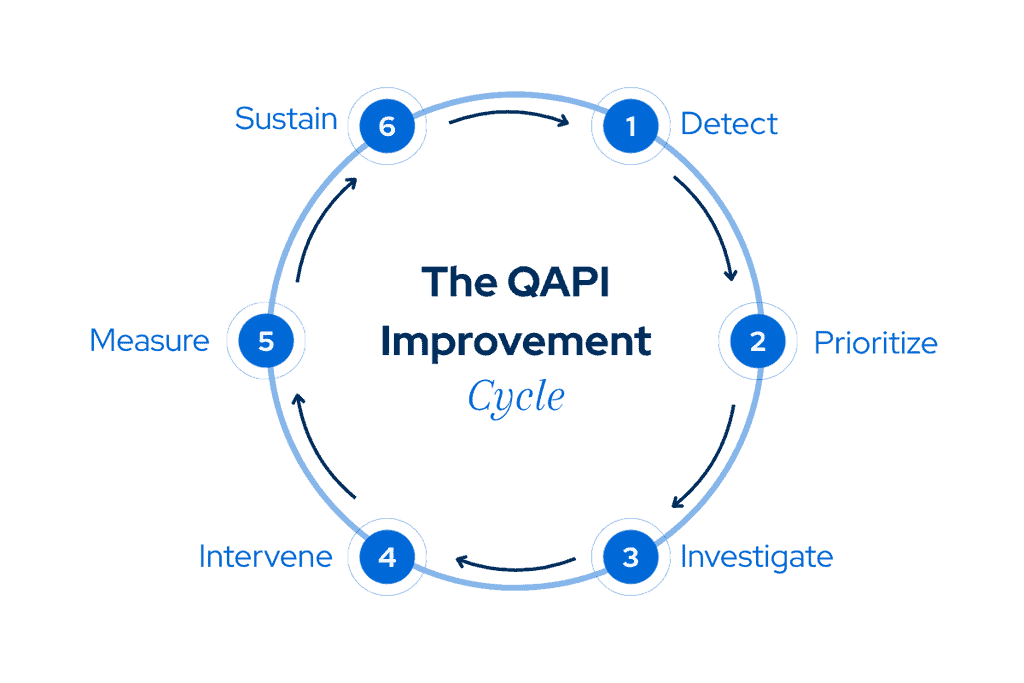
A useful way to evaluate QAPI readiness is to follow an issue through six stages:
Detect → Prioritize → Investigate → Intervene → Measure → Sustain →
Detect
Maintain enough visibility across clinical, quality, compliance, safety, and operational information to identify meaningful patterns. The objective isn’t to turn every isolated event into a performance improvement project (PIP). It’s to recognize when data indicate a recurring, systemic, high-risk, or otherwise important issue that deserves attention.
Prioritize
Organizations have finite resources, so QAPI requires choices. Consider factors such as patient safety, frequency, severity, regulatory exposure, operational impact, and whether a problem appears systemic. A recurring documentation issue affecting several branches warrants a different response than an isolated error that was promptly identified and corrected.
Investigate
Before prescribing a solution, understand what’s driving the result. The metric is the signal, not necessarily the explanation. For example, an increase in home health hospitalizations might prompt review of change-in-condition processes, medication management, care coordination, or characteristics of the patient population. For hospice, an unusual live-discharge pattern might prompt review of eligibility documentation, referral sources, length of stay, and individual clinical circumstances.
Intervene
Once the likely causes are understood, match the intervention to them.
Depending on the issue, that could mean:
- Workflow changes
- Policy clarification
- Targeted education or competency validation
- Changes in escalation processes
- Additional clinical review
- Technology safeguards or configuration changes
- Staffing or supervisory interventions
- Standardized handoffs
- Clearer ownership and accountability
Education can be part of an intervention, but documenting an in-service alone doesn’t demonstrate that a recurring process problem has been corrected.
Measure
Define how success will be evaluated before implementing the intervention. Establish the baseline and the measure that will show whether performance changed. Then remeasure or resample after the intervention. If the issue is order aging, measure whether aging improves. If the issue is late hospice activity, monitor whether required activity occurs within the applicable timeframe.
Sustain
Initial improvement isn’t the end of the QAPI cycle. Continue monitoring long enough to determine whether the change lasts. Successful improvements may need to become part of standard workflows, policies, monitoring, or other organizational processes. If performance deteriorates again, there should be a defined pathway for escalation.
QAPI readiness checklist for home health and hospice
Use the checklist below to evaluate whether the six stages of the QAPI cycle are operating in practice.
Detect
- We routinely review multiple sources of quality, safety, compliance, clinical, and operational information
- Our inputs include applicable complaints, grievances, incidents, adverse events, clinical outcomes, patient/caregiver experience, survey findings, internal audits, and documentation exceptions
- We have consistent definitions, data sources, owners, and review frequencies for important QAPI indicators
- We consider near misses and other safety signals when they may reveal process vulnerabilities
- Revenue-cycle and documentation exceptions can feed into QAPI review when they reveal recurring process problems
- We can identify meaningful variation by branch, team, discipline, service line, contractor, or patient population when appropriate
Home health check: Our monitoring incorporates applicable OASIS and other quality data, patient outcomes and safety, emergent care use, hospital admissions, hospital readmissions, medical errors, and relevant operational trends.
Hospice check: Our monitoring incorporates applicable comprehensive-assessment and palliative-outcome data, patient and family experience, adverse events, complaints, and relevant clinical, operational, contracted, and administrative functions.
Prioritize
- We have a defined process for deciding which findings warrant formal QAPI action
- Prioritization considers patient safety, risk, volume, frequency, severity, regulatory exposure, significant variation, and operational impact as appropriate
- Leadership can explain why current QAPI priorities were selected
- We distinguish isolated events from recurring or systemic patterns
- The rationale for selecting major performance improvement projects is supported by data
Home health check: Our PIP planning reflects the agency’s scope, complexity, and past performance. CMS interpretive guidance states that an HHA should have at least one PIP in development, underway, or completed during each calendar year.
Hospice check: Our PIP number and selection of projects reflect monitoring data, patient population, operational needs, past performance, and survey findings.
Investigate
- We investigate contributing factors before selecting an intervention
- Record review is used when needed to understand the clinical context behind a metric
- Frontline and interdisciplinary staff participate when their experience can help explain the process
- We consider whether policy, training, workflow, communication, technology, staffing, supervision, or unclear ownership contributed to the issue
- We look beyond the person closest to an error to identify potential system-level causes
- We examine whether the same condition could exist in other branches, locations, disciplines, or teams
Intervene
- Every improvement initiative has a clearly identified owner or accountable team
- Corrective actions address the likely cause rather than only the individual event
- Education is paired with competency validation or other controls when appropriate
- Actions have defined implementation dates and escalation paths
- Significant safety concerns receive appropriate immediate corrective action while broader causes are investigated
- Lessons learned are communicated to relevant staff and teams
Measure
- Each major QAPI initiative has a defined measure of success
- Baseline performance is documented where appropriate
- Measures have clear definitions, data sources, owners, and review frequencies
- We remeasure performance or resample records following interventions
- Leadership can determine whether the intervention produced the intended change
- When an intervention doesn’t work, we adjust the approach rather than simply closing the project
Sustain
- Successful improvements are incorporated into standard processes where appropriate
- We continue monitoring long enough to determine whether improvement is sustained
- Our sustainment approach identifies who will monitor performance and how frequently
- We have a threshold or trigger for escalation if performance declines
- Lessons learned at one location are evaluated for relevance elsewhere in the organization
- Significant QAPI findings, actions, and progress reach executive leadership and the governing body as appropriate
- QAPI documentation provides evidence of what was identified, what changed, whether it worked, and whether improvement continued
Home health check: Governing-body oversight includes the QAPI program and applicable patient-safety responsibilities, including oversight of fraud and waste. The governing body also approves the frequency and level of detail of QAPI data collection.
Hospice check: The governing body evaluates the QAPI program at least annually, and one or more individuals are designated to operate the program.
Four QAPI misunderstandings worth clearing up
Even well-established programs can get sidetracked by a few common assumptions.
“A written QAPI policy means we’re ready.”
A policy establishes the framework. Evidence that QAPI is actually operating comes from the data, analysis, decisions, interventions, measurement, leadership oversight, and sustained improvements that follow.
“Every deficiency needs a PIP.”
Not necessarily. Some findings call for immediate correction and continued monitoring. Formal improvement projects should be prioritized based on factors such as risk, volume, severity, recurrence, and performance data.
“Submitting OASIS or hospice quality data is QAPI.”
Those data can be important inputs, but reporting alone isn’t performance improvement. The QAPI process requires organizations to interpret information, establish priorities, act, remeasure, and determine whether improvement lasts.
“Training proves we corrected the problem.”
Training demonstrates that education occurred. It doesn’t by itself demonstrate competency, implementation, effectiveness, or sustained improvement. If the underlying cause involves workflow, technology, staffing, communication, supervision, or another system factor, the intervention should address that cause.
Five-question test for your QAPI program
The strongest QAPI programs create a visible connection between the original signal and sustained improvement.
For each of your organization’s three highest-priority QAPI initiatives, ask:
- What did we find?
- Why was it happening?
- What did we change?
- Did the change work?
- Is the improvement lasting?
If you can follow each major initiative through that entire sequence, you have evidence of a closed improvement loop. If the answers stop at “we identified the problem,” “we discussed it,” or “staff were educated,” there may be an opportunity to strengthen the program.