
How Adoration Health Streamlined Hospice EHR Transitions with HCHB
Adoration Health shares how a new hospice transition workflow helped reduce repetitive administrative work during an EHR transition while preserving clinical review and oversight.
Hospice EHR transitions present an unusual operational challenge. Whether they’re driven by an acquisition, database consolidation, or conversion from another electronic health record (EHR), providers may need to move hundreds or thousands of existing patients into a new system while clinicians and branch teams continue caring for patients and admitting new ones.
Transitioning an established hospice patient isn’t the same as admitting a new patient.
With a new hospice admission, clinical and operational teams need to establish the patient record, validate clinical information, confirm the plan of care, and complete the appropriate reviews. During an EHR transition, much of that clinical information already exists. The challenge becomes finding a way to efficiently transfer and validate what’s already known without removing the clinical oversight that still matters.
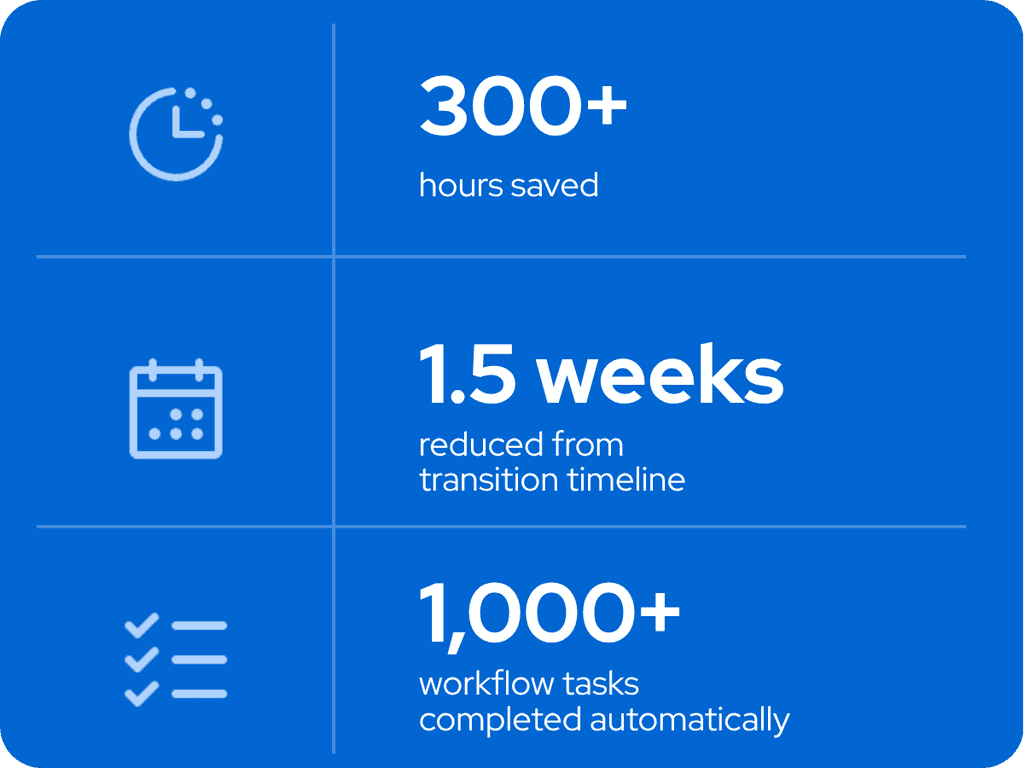
That distinction became the foundation for a collaboration between Adoration Health and HCHB to develop and pilot the Hospice Transition Workflow Accelerator. In March 2026, Adoration Health piloted the workflow with 214 patients across three branches. The pilot saved more than 300 hours, automatically completed more than 1,000 workflow tasks, and shortened the transition timeline from approximately four weeks to two and a half weeks.
We spoke with Christy Evans of Adoration Health about the challenge that inspired the project, how the teams approached hospice workflow automation, and what Adoration Health learned from putting the new transition process into practice.
What benefits does Adoration Health see from using HCHB across home health and hospice?
“The first benefit would be regulatory compliance. I definitely think there are good safeguards in place, both from the back office and PointCare, to make sure we’re compliant from a regulatory perspective and keeping those things up to date. HCHB is always ahead of the game in looking at regulatory updates and making updates in the system to help make sure we’re compliant.
It’s also a benefit having both of our service lines in one EHR because there is a lot of transition, specifically from home health to hospice, with patients moving from one business line to the other. It’s helpful to have that 30,000-foot view of both service lines and how we’re working together across the patient’s continuum of care and following the lifecycle of the patient. Additionally, I would say there are revenue cycle benefits within the system as well. The functionality HCHB has on the revenue cycle side has benefited our revenue cycle teams.”
How does having home health and hospice in the same EHR help in practice?
“The first thing is that it makes reporting easier. You’re pulling information from the same system, and you can see that full lifecycle: We originally got this patient in one business line, had them for a certain amount of time, and then were able to transition them to a different business line as their needs changed.
It also helps a lot with internal communication within our branches. If you add a patient for hospice and they’ve already been on home health, their patient record and demographics are already there. You can pull from that information, which helps streamline putting in the referral.
Then you can really see that holistic lifecycle of the patient. That’s important for us at Adoration Health because we have other business lines outside of home health and hospice, including pharmacy and long-term care facilities. It’s beneficial for us to be involved in that patient’s care beyond just home health and hospice and to be able to provide services across those different business lines.
Being able to bring the data together from home health and hospice is extremely helpful as we partner across our internal business lines to make sure we’re taking the best care of the patient.“
What has been valuable about HCHB from a revenue cycle perspective?
“I think the functionality is very intuitive. I like how hospice and home health have different consoles for the different business lines, where things are segregated by the type of claims. At a higher level, though, you can still run reports and bring all of that data together. That setup is helpful because we have teams separated by business line within Adoration Health. They have the flexibility to maintain that separation, while the VP and SVP of the overall revenue cycle department can still run reports and look at things holistically.”
What led Adoration Health and HCHB to rethink the hospice transition workflow?
“When you’re transitioning patients from another EHR into HCHB, it can be very time-consuming. If it’s a patient we have had on service for a while and we’re truly just doing data entry, you’re looking at the information in one place, taking the data, and plugging it in somewhere else. The question became: How can we work smarter and not harder? How can we help our clinicians get all of this information into the system in a quicker way so they can get back out there and actually take care of our patients? That was really where the conversation started.”
Why is transitioning an existing hospice patient different from admitting a new patient?
“With a brand-new patient, you need those checks and balances. You need the right clinical representative reviewing the information and making sure everything is correct because you’re establishing that patient in the system. With a transition patient, we already know the patient. We already have their information. We have a plan of care. We’re really transferring information from one system into another. We still need clinical review. We still need to make sure the information is accurate. But there are steps in that process that don’t necessarily need to be repeated when we already know the patient and already have that clinical information. That was really the focus: What can we streamline without taking away the clinical review and oversight that we need?”
How did Adoration Health decide which parts of the workflow could change?
“It was very collaborative. We involved our technology team, operations, clinical leadership, quality, and compliance. We wanted to make sure that anything we changed still met our requirements. There were conversations around things like chaplain and social worker transition visits. We looked at whether those transition-specific visits were necessary while still making sure those disciplines were establishing their plans of care through the appropriate follow-up visits. It was really about looking at each piece and asking: Is this something that needs clinical judgment? Is this something that needs to be reviewed? Or is this something that is more administrative and can be automated?”
What changed in the accelerated hospice transition workflow?
“There were several workflow tasks that could be automated or eliminated because the information was already known and verified. One example was the plan-of-care review. Previously, the clinical manager could essentially be reviewing the same information three different times. We were able to get that down to one comprehensive review. They’re doing the comprehensive review, and then they’re done.
We also looked at the transition visits for chaplains and social workers. Instead of requiring those transition visits before everything could move forward, we could make sure the appropriate follow-up visits were scheduled so those disciplines could establish their plans of care in the new system. The goal wasn’t to take clinical responsibility out of the process. It was to remove repetitive work where we could and keep the review where it was meaningful.”
What did the Hospice Transition Workflow Accelerator pilot look like?
“We piloted it with 214 patients across three branches. We intentionally started smaller because we wanted to make sure the process worked. We had team members involved who knew the transition process backwards and forwards, so they could identify when something didn’t work the way we expected. If something was supposed to automatically complete and didn’t, we could flag that for the HCHB team. They could look at it, figure out what happened, and make the appropriate adjustment. That partnership was very important. We knew we were piloting something new, so we expected that we would learn things along the way.”
What results did Adoration Health see?
“We saved more than 300 hours through automation, and more than 1,000 workflow tasks were completed automatically. The traditional hospice transition timeline was about four weeks, and with the accelerator, it was about two and a half weeks. So we reduced the transition timeline by about a week and a half. We knew we got benefits, but I don’t think everyone understood the extent of the benefits we received with only 214 patients until we saw those numbers and when you start looking at what that could mean at a larger scale, it becomes significant.”
Why do those time savings matter beyond the EHR transition itself?
“A lot of this work falls on our clinical managers, and they have many other responsibilities. They’re helping coordinate with our staff and taking care of our current patients while also getting this transition process done. The more we can take off of them, the more they can focus on taking care of our employees and, in turn, making sure our patients are taken care of. That’s really the important part. We want our clinicians and clinical leaders focused on the work that requires their expertise, rather than spending time clicking through tasks.”
What role did collaboration play in making the pilot successful?
“Constant communication was really important. We had technology, operations, clinical, quality, and compliance involved, and we were working closely with the HCHB implementation team. Having people from Adoration Health who really understood the transition process was important because they could identify the small things that might otherwise have been missed. Then we could work with HCHB to determine what was happening and how to correct it. It was very much a partnership. We were all trying to get to the same place: making the transition process better while making sure we were doing it appropriately.”
Where could Adoration Health use this approach next?
“We’re looking at potentially consolidating our hospice business line from two HCHB instances into one. That would be at a much larger scale, approximately a 5,000-patient census. We are hoping to leverage the workflow accelerator for that project so we can move those patients with as little operational impact as possible. We still have to take care of our current patients. We still have to admit new patients. The business doesn’t stop while you’re doing a transition. So anything we can do to make that process more efficient helps us continue operating while the transition is happening.”
Could the accelerator also support future acquisitions?
“Yes. That’s really the long-term goal. We do acquisitions, and newly acquired locations are already going through a lot of change. They’re becoming part of Adoration Health, learning new processes, and potentially changing systems. The long-term goal would be to leverage this for acquisitions and make that transition easier to create a better experience for our newly acquired locations. If we can take some of that administrative burden out of the EHR transition, that’s one less thing those teams have to manage while they’re going through all of the other changes that come with an acquisition.”
What is the larger takeaway from the project?
“For me, it comes back to working smarter and not harder. There are parts of the process where we absolutely need clinical judgment and oversight, and we don’t want to remove those. But there are also administrative steps that technology can help us complete more efficiently. If we can automate those pieces and give that time back to our clinicians and clinical leaders, they can spend more time supporting their employees and taking care of patients. That’s ultimately what we’re trying to accomplish.”
A more efficient approach to hospice EHR transitions
Adoration Health’s experience highlights an important distinction for hospice organizations considering an EHR conversion, acquisition, database consolidation, or other large-scale patient transition: streamlining a transition doesn’t have to mean removing the clinical safeguards built into hospice workflows.
Instead, the opportunity is to identify where established patient information can move more efficiently, where repetitive administrative tasks can be automated, and where clinical review and human judgment still need to remain firmly in the process.
For Adoration Health, the Hospice Transition Workflow Accelerator turned that principle into measurable results. Across its 214-patient pilot, more than 1,000 workflow tasks were completed automatically, more than 300 hours were saved, and the transition timeline was reduced by approximately 1.5 weeks.
But the larger opportunity extends beyond a single hospice EHR implementation. As Adoration Health considers database consolidation and future acquisitions, the same transition-specific approach could provide a repeatable way to reduce operational disruption while allowing clinical and branch teams to stay focused on their day-to-day responsibilities.
As Evans explained, the objective is ultimately simple: use technology to reduce the work that doesn’t require a clinician’s expertise so clinicians and clinical leaders can spend more of their time supporting their teams and caring for patients. For more information, please visit www.adorationhealth.com or follow them on LinkedIn.