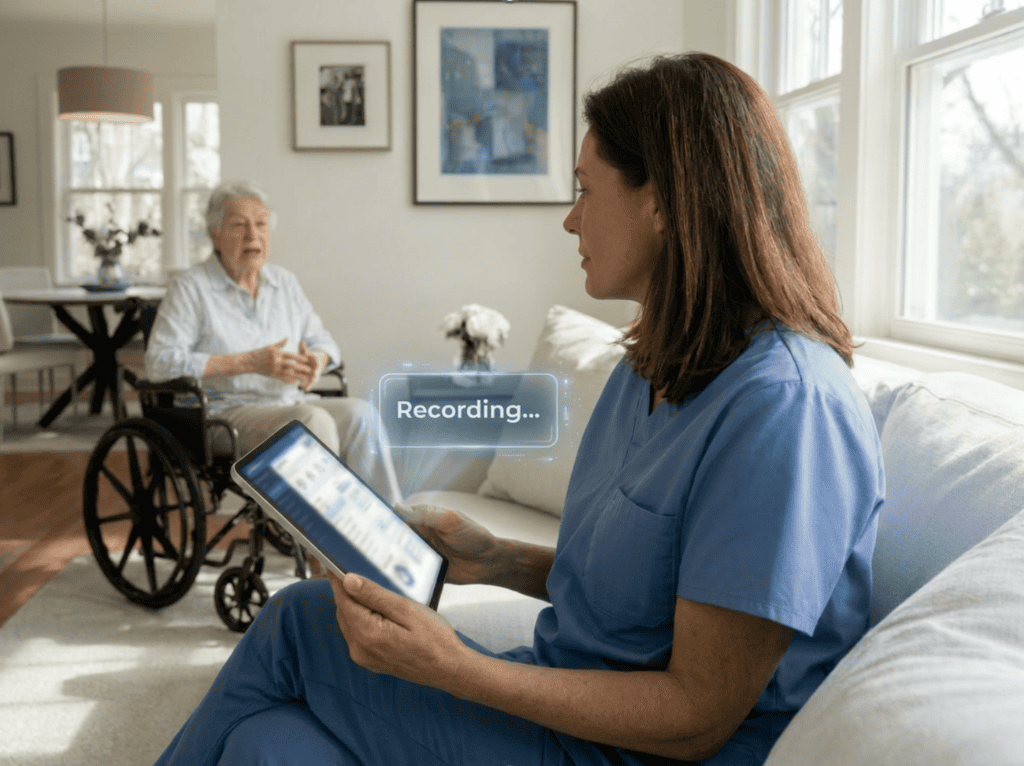
In a great home care experience, clinicians are listening, asking thoughtful questions, and staying fully engaged during the visit while documentation support works quietly in the background. That’s the opportunity behind ambient listening technology in healthcare.
So, what is ambient listening? In healthcare, ambient listening refers to AI-assisted technology that securely captures and processes conversations during patient encounters to support clinical documentation workflows. Instead of manually typing notes during or after visits, clinicians can review AI-generated drafts that help streamline documentation while maintaining clinician oversight and control. As administrative demands continue to grow across healthcare, ambient listening is becoming an important part of the conversation around clinician efficiency, documentation quality, and care experience improvement.
What is ambient listening in healthcare?
Ambient listening in healthcare uses speech recognition, natural language processing (NLP), and AI-enabled documentation assistance to capture relevant details from clinician-patient conversations and generate structured clinical notes. Unlike traditional dictation tools, ambient listening technology works in the background during natural conversations. The clinician does not need to pause the visit to dictate line-by-line notes or manually navigate documentation workflows throughout the encounter.
Instead, the technology helps surface clinically relevant information that can support documentation creation, including:
- Patient symptoms and concerns
- Medication discussions
- Clinical observations
- Assessments and interventions
- Follow-up recommendations
- Care plan discussions
The clinician remains responsible for reviewing, validating, and finalizing documentation before it becomes part of the medical record. This human-in-the-loop approach is especially important in regulated healthcare environments where documentation accuracy, compliance alignment, and clinical judgment remain essential.
How ambient listening technology works
Ambient listening solutions typically follow a multi-step workflow designed to support documentation efficiency while preserving clinician control.
1. Secure audio capture during the visit
The clinician activates the documentation assistant within the workflow. The technology securely processes the conversation as the visit occurs. Advanced systems are designed to function within real-world care environments, including home-based care settings where conversations may include caregivers, background noise, or changing environments.
2. AI-assisted processing and note generation
The system analyzes the conversation using AI and NLP models trained to recognize clinical context and documentation structures. Rather than creating a raw transcript, the technology helps organize relevant information into documentation-ready formats such as:
- OASIS or HOPE assessments
- Visit summaries
- Medication updates
- Care coordination details
Some platforms can also help pre-populate structured documentation fields or surface relevant patient context within the workflow.
3. Clinician review and finalization
The clinician reviews the generated documentation, makes edits as needed, and confirms accuracy before submission. Responsible AI design keeps clinicians in control of the final documentation process rather than replacing clinical judgment.
Why ambient listening is gaining momentum
Ambient listening adoption has accelerated across healthcare as organizations look for ways to reduce administrative burden and support clinician retention. Documentation requirements continue to expand across home health, hospice, palliative care, and broader healthcare settings. Clinicians often spend significant time completing notes after visits, contributing to after-hours charting and workflow fatigue.
AI-assisted documentation tools are increasingly being explored as a way to:
- Reduce documentation burden
- Improve workflow efficiency
- Support clinician satisfaction
- Streamline start-of-care documentation
- Help improve documentation consistency
- Allow clinicians to focus more attention on patients during visits
For home-based care organizations specifically, the opportunity is especially meaningful. Clinicians often document in highly variable environments while managing complex care coordination and compliance requirements. When thoughtfully embedded into workflows, ambient listening can support more natural care interactions without removing clinician oversight.
The benefits of ambient listening technology
More time focused on patient care
One of the biggest advantages of ambient listening is reducing time spent on manual documentation tasks. By helping clinicians complete documentation more efficiently, organizations may be able to reduce after-hours charting and administrative workload pressures.
Improved care experience
When clinicians spend less time typing and navigating screens, patient interactions often feel more connected and conversational. This can help strengthen communication, engagement, and overall care experiences.
Better workflow integration
Modern AI-enabled documentation tools are increasingly being embedded directly into electronic health record (EHR) workflows instead of functioning as disconnected applications. Embedded intelligence within workflow helps reduce friction and creates a more streamlined clinician experience.
Support for documentation consistency
Structured AI-assisted workflows can help support more consistent documentation patterns while still requiring clinician review and approval. In regulated care environments, documentation consistency plays an important role in supporting quality reporting, reimbursement workflows, and audit readiness.
Ambient listening requires responsible AI design
As healthcare organizations evaluate AI-enabled documentation technologies, governance and clinician trust remain critical.
Responsible AI in healthcare should include:
- Clinician oversight and final approval
- AI transparency
- Explainability and auditability
- HIPAA-aligned security practices
- Embedded workflow integration
- Bias monitoring and governance controls
AI should support clinicians, not replace them. This requires clinician-controlled experiences designed to support efficiency while preserving transparency and human judgment.
Ambient listening in home-based care
Home-based care environments introduce unique complexity for ambient listening technologies.
Unlike controlled clinic settings, home-based care visits may involve:
- Multiple family members speaking
- Background televisions or pets
- Variable internet connectivity
- Dynamic visit workflows
- Unstructured care environments
That’s why workflow-aware AI design matters. Ambient listening tools built for home-based care must adapt to the realities of home settings and real clinical workflows rather than forcing clinicians to change how they deliver care. The goal is not simply faster note generation. The goal is helping clinicians document care more naturally while supporting quality, compliance, and operational efficiency.
The future of AI-assisted documentation
Ambient listening is part of a broader shift toward AI-enhanced healthcare workflows.
The next generation of AI-enabled clinical experiences will likely include:
- Embedded documentation assistance
- AI-assisted medication workflows
- Predictive clinical insights
- Workflow orchestration support
- Intelligent scheduling optimization
- Revenue cycle workflow assistance
The organizations seeing the most success with AI are not simply adding isolated tools. They are embedding intelligence directly into care delivery and operational workflows with governance, transparency, and clinician partnership at the center.
How Homecare Homebase approaches AI and ambient listening
Homecare Homebase is building AI capabilities designed specifically for the realities of home-based care. Our AI strategy focuses on embedded intelligence within workflows, combining large language models with proprietary healthcare-specific models, human-in-the-loop and governance controls, and clinician-centered design.
This includes innovations designed to support:
- AI-assisted documentation workflows
- Ambient listening capabilities
- Predictive hospitalization risk insights
- Operational workflow optimization
Curate: Scribe, our clinician-controlled ambient documentation capability embedded within the Care+ experience, is designed to help clinicians reduce documentation burden while maintaining transparency, accuracy, and oversight.
To learn more about how responsible AI is shaping the future of home-based care operations and clinical workflows, explore our latest report: AI in Clinical & Revenue Operations.
 AI in Clinical & Revenue Operations